



 Français
 Español
 Deutsch
Content
- 1 Product Overview
- 2 Technical Specifications
- 3 How the Construction Supports Comfort
- 4 Breathable Design for Everyday Bedding
- 5 Visual Appeal and Premium Bedding Coordination
- 6 Advantages Over Basic Mattress Protectors
- 7 Advantages Over Bulky or Uneven Bed Layers
- 8 Advantages Over Plain, Low-Value Bedding Designs
- 9 Manufacturing Capabilities of the Supplier
- 10 Advanced Production and Quality Management
- 11 Quality Control Considerations
- 12 Packaging, Logistics, and Retail Presentation
- 13 Suitable Market Applications
- 14 Ordering and Customization Discussion
- 15 Care and Use Guidance
- 16 Comparison of Product Positions
- 17 Why Polyester Is a Practical Material Choice
- 18 Sustainability and Responsible Production
- 19 Quality, Innovation, and Customer Service
- 20 Frequently Asked Questions
- 20.1 What is the main function of this mattress topper?
- 20.2 What size is specified for the product?
- 20.3 What materials are used on the front and back?
- 20.4 Does the product provide waterproof protection?
- 20.5 What makes the knitted surface different from a basic polyester cover?
- 20.6 What is the purpose of the vertical design?
- 20.7 Why is piping used around the edge?
- 20.8 Is the topper suitable for hotels or guest accommodation?
- 20.9 Can the topper be combined with other bedding products?
- 20.10 Can private-label packaging be requested?
- 20.11 Are other colors or sizes available?
- 20.12 What should buyers inspect before approving a bulk order?
- 21 Recommended Buyer Evaluation Checklist
- 22 Conclusion
- 23 References
- 24 Product: Knitted Fabric Mattress Topper
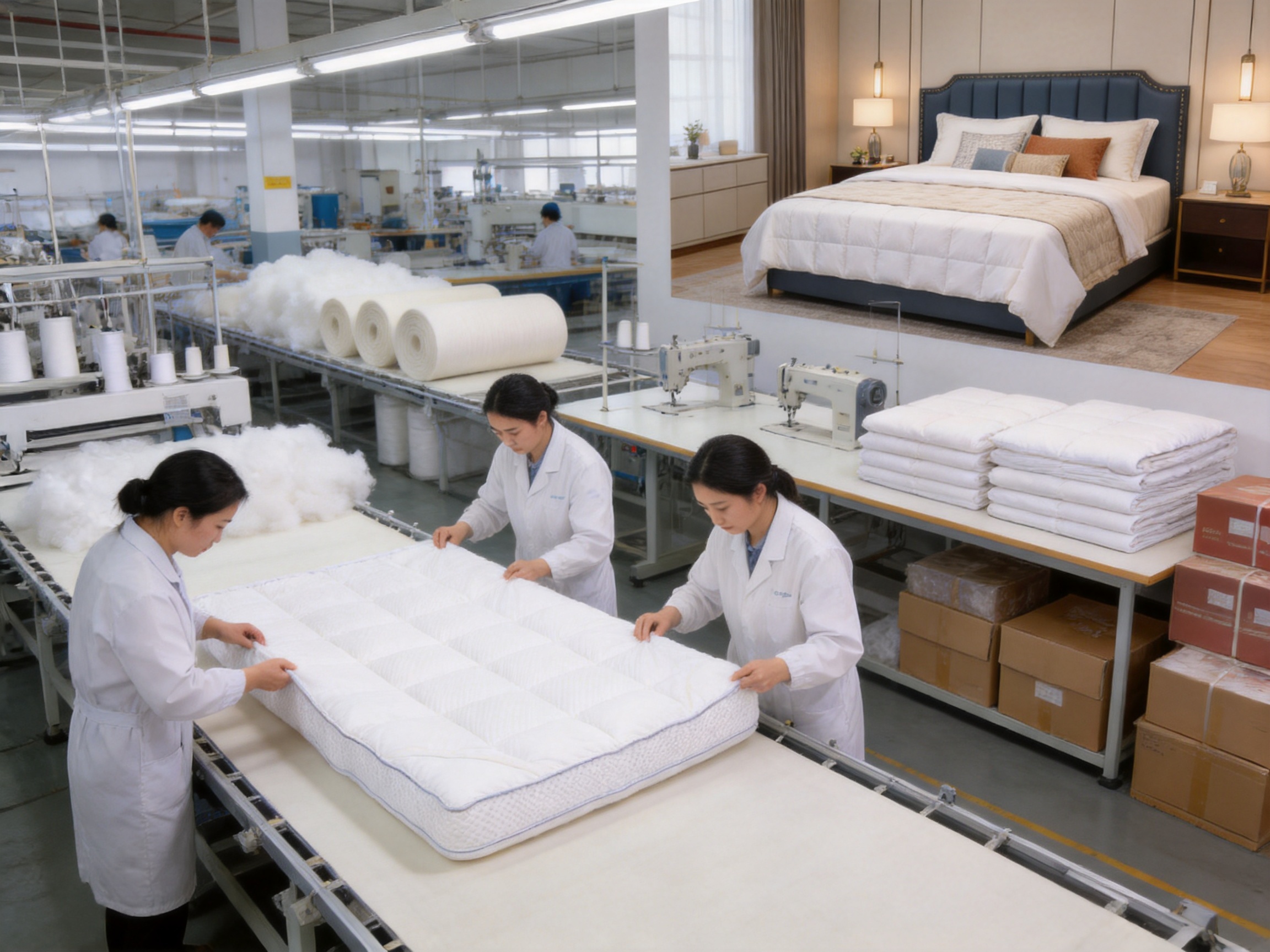
A mattress topper is one of the simplest ways to improve the comfort, appearance, and practical performance of a bed. It sits above the mattress and below the fitted sheet, creating an additional layer between the sleeper and the underlying mattress surface. The Knitted Fabric Mattress Topper described in this article has been designed to combine a soft, attractive sleeping surface with supportive polyester filling, breathable construction, and durable finishing details. It is suitable for bedding retailers, hospitality suppliers, furniture brands, interior furnishing companies, and distributors seeking a refined polyester mattress protector or bed spread.
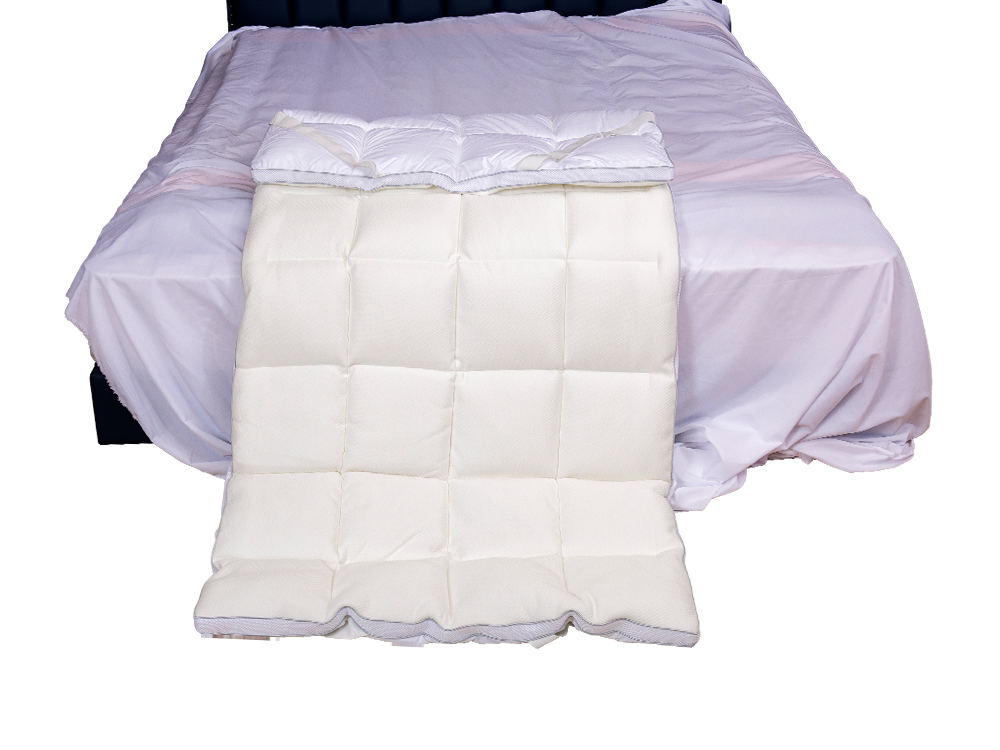
The product is distinguished by its 250gsm polyester knitted fabric surface, 80gsm brushed fabric backing, and 800gsm 6D polyester filling. Together, these materials create a topper with an approximate height of 4 centimeters. The front surface provides a comfortable hand feel and a contemporary appearance, while the filling adds loft and cushioning. The back fabric helps create a stable layer against the mattress, and the overall construction is completed with a breathable vertical design and carefully executed piping.
Unlike a very thin mattress protector whose primary purpose is surface protection, this product is designed to offer a more noticeable comfort upgrade. Unlike a bulky quilted bed layer, it can provide a neater, more controlled profile that remains compatible with ordinary bedding arrangements. Its knitted face also gives it a more premium visual character than many basic woven polyester covers. These qualities make it a versatile option for customers who want bedding that looks polished while also improving the everyday feel of the bed.
Knitted Fabric Mattress Topper
Product Overview
The Knitted Fabric Mattress Topper is made for a 120 by 200 centimeter mattress and has a stated height of 4 centimeters. This size is suitable for a single or narrow sleeping configuration, depending on the market and bed system. Because the product is manufactured as a textile bedding layer rather than as a rigid mattress insert, it can be rolled, folded, packed, transported, and presented efficiently through retail or project-based distribution channels.
The front side uses 250gsm polyester knitted fabric. Knitting gives the surface a flexible structure and a distinctive tactile quality. Compared with a plain, low-weight fabric, a knitted surface can appear fuller and more dimensional. It can also follow the movement of the filling more naturally, helping the finished product look soft rather than flat. The visible surface is therefore not only functional but also part of the product’s decorative value.
The reverse side uses 80gsm brushed fabric. Brushing creates a softer, slightly raised feel and helps the backing sit comfortably against the mattress or beneath the fitted sheet. The backing is intentionally lighter than the front fabric so that the product can retain a balanced construction without unnecessary weight. It supports the topper’s practical use while allowing the knitted top to remain the visual and tactile focus.
Inside the topper is 800gsm 6D polyester filling. The term 6D refers to the fiber specification used for the filling, while the stated weight indicates the amount of filling per square meter. Polyester fiber is widely used in home textiles because it can provide resilience, low moisture absorption, stable handling, and consistent production performance. In this design, the filling contributes to the topper’s loft and cushioning without requiring natural down or other animal-based materials.
The product also features a breathable vertical design. This design element can support a more orderly distribution of the interior material and gives the surface a clean, elongated visual rhythm. The vertical lines add structure to the appearance and may help the topper retain a more consistent form during ordinary use. Exquisite piping around the edges further defines the shape and gives the product a finished appearance suitable for high-end bedding combinations.
Technical Specifications
Product type |
Knitted fabric mattress topper |
Product category |
Polyester mattress protector and bed spread |
Available size in the supplied specification |
120 x 200 centimeters |
Approximate product height |
4 centimeters |
Front fabric |
250gsm polyester knitted fabric |
Back fabric |
80gsm brushed fabric |
Filling |
800gsm 6D polyester |
Construction features |
Breathable vertical design and decorative piping |
These specifications provide a clear basis for product selection and comparison. Buyers can assess the product according to surface weight, backing construction, internal filling, height, and finished appearance rather than relying only on general descriptions such as “soft” or “comfortable.” This makes the topper easier to position in a professional product catalog and easier for retailers to explain to end customers.
How the Construction Supports Comfort
Comfort in a mattress topper is influenced by several factors, including surface softness, filling resilience, thickness, temperature management, and the way the product stays in place. No single material determines the complete sleeping experience. The Knitted Fabric Mattress Topper uses a layered construction so that each component contributes a different function.
The knitted face is the first point of contact between the topper and the sheet. Its textile structure provides a smoother and more flexible hand feel than a stiff, tightly finished cover. This is particularly useful for customers who place importance on touch and visual softness. A knitted fabric can also create a fuller appearance, making the bed look more inviting when it is dressed with a fitted sheet, flat sheet, duvet, or decorative bed covering.
The 800gsm polyester filling gives the topper a substantial internal layer. With a stated overall height of approximately 4 centimeters, it is more than a minimal protective pad. The filling is intended to add cushioning and create a softer transition over the mattress. It may be useful where the underlying mattress feels firm, where a guest bedroom needs an additional comfort layer, or where a bedding retailer wants to offer a visible upgrade over a basic protector.
The filling is also arranged within a designed textile structure rather than being left as an unrestrained loose layer. The vertical design helps the product present a more orderly surface and can contribute to even visual distribution. Properly controlled quilting and stitching are important in this type of product because they help limit excessive movement of the filling during handling and use. They also help maintain the topper’s recognizable design after it has been packed and unpacked.
The brushed backing adds another comfort-related benefit. Because the backing has a soft raised finish, it is less harsh against the mattress fabric than a coarse or untreated textile might be. It can also help reduce the impression of sliding, although actual stability will depend on the mattress cover, bed frame, fitted sheet, and conditions of use. The backing is not described as a waterproof membrane, so the product should be positioned as a comfort-oriented mattress topper and textile protector rather than as a fully waterproof mattress encasement.
Breathable Design for Everyday Bedding
Breathability is an important consideration in bedding. During sleep, heat and moisture are naturally produced by the body. Bedding that feels excessively dense or poorly ventilated may become uncomfortable, especially in warm seasons or in rooms with limited air movement. The vertical design of this topper is intended to support a lighter, more breathable visual and structural effect than a solid, heavily compacted layer.
Polyester is a versatile fiber, but the final breathability of a textile product depends on more than fiber content alone. Fabric weight, yarn construction, stitch structure, filling arrangement, quilting density, and the presence or absence of coatings all influence air movement. The knitted face, brushed backing, and vertical construction work together as a textile system. The product therefore offers a more considered design than a simple flat polyester pad.
For distributors, the breathable design is also a useful selling point because it connects comfort with appearance. The vertical lines can communicate lightness and order, while the knitted fabric suggests softness. This makes it possible to position the topper for customers who want a bed layer that feels comfortable without appearing overly heavy or old-fashioned.
Breathability should always be described accurately. The product is not presented as a temperature-regulating technical mattress or as a medical sleep product. Instead, its construction is intended to provide a comfortable textile layer with a breathable design and a soft, elevated surface. Clear communication helps protect customer expectations and supports long-term confidence in the product.
Visual Appeal and Premium Bedding Coordination
Many mattress toppers are purchased not only for their functional contribution but also for their effect on the finished bed. A bed is often a central visual feature in a bedroom, guest room, hotel, furnished apartment, or showroom. A topper with a flat, ordinary surface may disappear beneath the sheet, while one with a refined construction can help bedding appear fuller and more carefully coordinated.
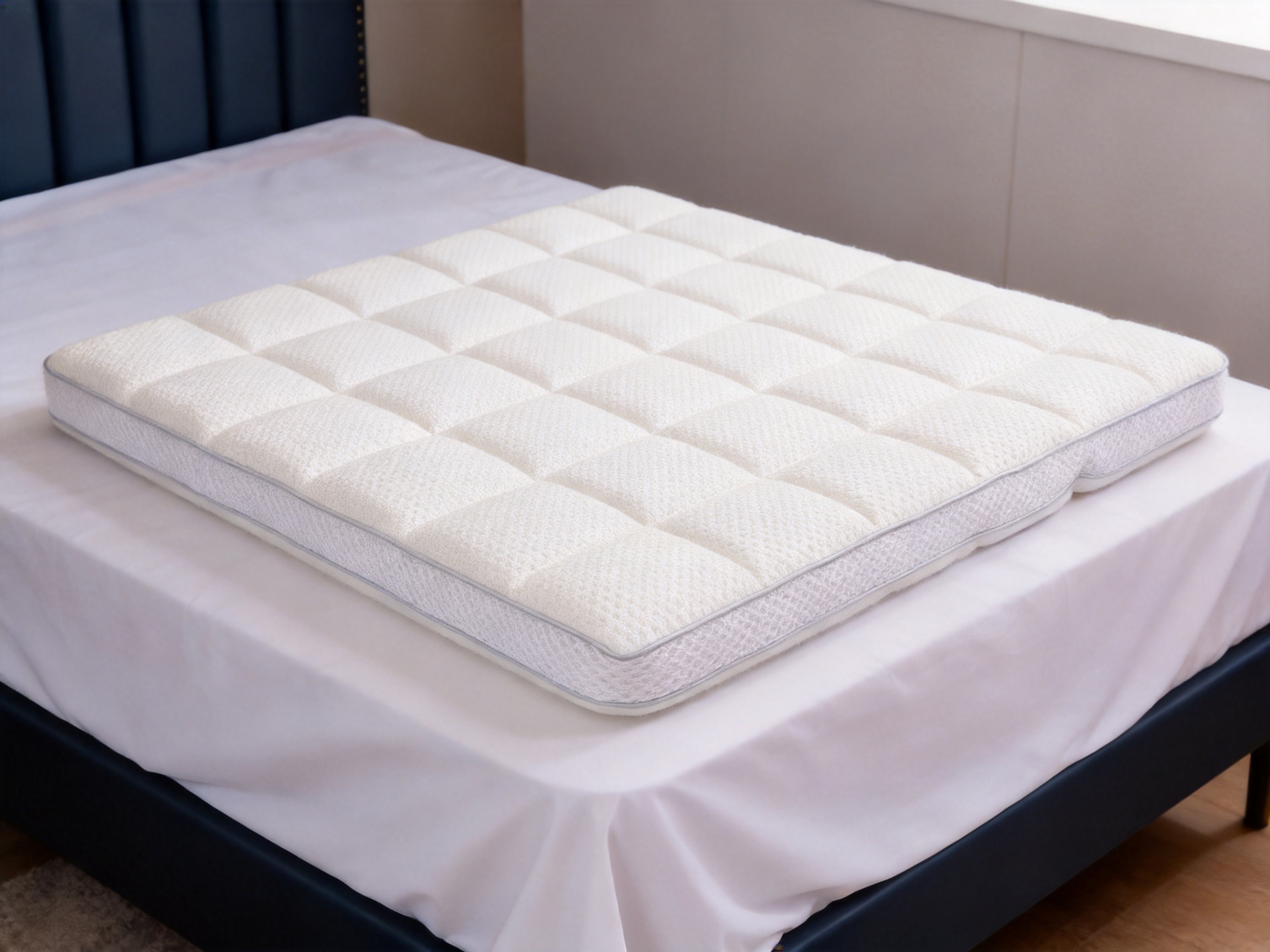
The knitted fabric gives this topper a modern textile character. Its surface has a more tactile appearance than a simple plain-weave cover and can complement contemporary bedroom interiors. The vertical design introduces a subtle pattern without relying on bright graphics or complicated decoration. This makes the product easier to combine with a wide range of bedding colors and styles.
Piping is another important visual detail. It follows the outer edge and gives the topper a defined border. This helps prevent the product from looking unfinished or shapeless. High-quality piping can also reinforce the edge visually and create a clean transition between the front and back materials. When the topper is displayed in a retail environment, the edge finish may be especially important because customers can see and touch the product directly.
The combination of knitted fabric, vertical detailing, and piping allows the topper to accompany high-end bedding without competing with it. It can sit beneath a duvet set, quilt, or decorative cover and contribute to the overall impression of a carefully made bed. For hotels and furnished accommodation providers, this appearance can support a consistent room presentation. For home textile retailers, it can help create cross-selling opportunities with sheets, pillow protectors, quilts, blankets, and cushions.
Advantages Over Basic Mattress Protectors
A basic mattress protector often has a thin construction focused primarily on protecting the mattress from ordinary dust, friction, and minor surface contact. Such products can be useful, but they may not provide much additional cushioning or visual appeal. The Knitted Fabric Mattress Topper occupies a different position because it combines protective bedding functionality with a thicker, fuller comfort layer.
Its 4-centimeter height gives the product a more substantial presence than a very thin pad. The 800gsm filling also provides a clear material basis for the additional loft. This can make the topper more attractive to customers who want to change the feel of a mattress without replacing the entire mattress. It may also be an economical way for accommodation operators to offer a softer bed surface while maintaining a consistent underlying mattress specification.
The front fabric is another point of distinction. Instead of using a basic, visually plain polyester cover, the product uses a 250gsm knitted surface with a premium hand feel. This supports a stronger retail presentation and allows the topper to be marketed as part of a comfort and bedroom styling collection. The product is therefore not limited to a purely utilitarian role.
The topper is also different from a waterproof protector. No waterproof layer is specified in the product information, so it should not be represented as a substitute for an impermeable mattress cover where liquid protection is the main requirement. However, this distinction can be commercially useful. Retailers can offer the topper together with a waterproof protector, fitted sheet, or mattress encasement, creating a layered bedding solution for different customer needs.
Advantages Over Bulky or Uneven Bed Layers
Some thicker quilts and loose comforters can add softness, but they may not maintain an even profile over the mattress. Loose filling can shift, edges may become irregular, and the product may not sit neatly under a fitted sheet. The Knitted Fabric Mattress Topper is designed as a dedicated mattress layer, with a shaped textile construction, specified dimensions, vertical design, and piped border.
The structured design helps create a more controlled appearance. A customer who wants extra comfort but prefers a neat, orderly bed may find this format more attractive than placing a folded quilt beneath the sheet. The product can provide an additional layer while retaining the identity of a mattress topper rather than functioning as an improvised blanket.
The 6D polyester filling is suitable for a product that must be handled repeatedly through manufacturing, packaging, transportation, installation, laundering according to care instructions, and regular use. Polyester fibers are commonly selected for their practical performance and consistent availability. While the exact recovery characteristics depend on fiber processing and quilting, the specified filling gives manufacturers a repeatable material platform for production.
The lighter brushed backing also helps avoid an unnecessarily heavy reverse construction. The product’s design puts material where the consumer experiences the greatest benefit: a fuller knitted top and a substantial inner layer. This balance can help control product weight while preserving a premium appearance.
Advantages Over Plain, Low-Value Bedding Designs
Price-sensitive bedding products often reduce construction to the simplest possible combination of fabric and filling. That approach may satisfy basic demand, but it can make it difficult for retailers to build a clear difference between entry-level and premium products. This topper offers several visible and tactile features that can support a higher-value product position.
The 250gsm knitted face is immediately distinguishable by touch. The vertical design is visible when the product is displayed or photographed. Piping adds a refined edge finish, and the 4-centimeter height communicates a fuller construction. These details create multiple points of differentiation instead of relying on a single decorative label.
For private-label customers, the product can serve as a foundation for a bedding collection. It can be paired with coordinated quilts, pillows, cushions, blankets, bedspreads, and mattress covers. Because the topper has a neutral, structured design, it can fit into collections aimed at modern homes, guest rooms, hospitality projects, and general home textile retail.
These advantages do not mean that every customer should choose a thick topper. Some sleepers prefer a very firm mattress surface, and some bed frames have limited clearance below the headboard or fitted sheet. The product is best positioned for consumers who want a noticeable comfort layer, a soft surface, and an enhanced visual finish.
Manufacturing Capabilities of the Supplier
Tongxiang Xinlong Bedding Co., Ltd. was established in January 2002 and operates in Wuzhen, Tongxiang, Zhejiang Province, China. The company specializes in home textile products, including quilts, pillows, cushions, bedspreads, travel quilts, mattress protectors, blankets, quilt covers, pillowcases, shower curtains, and curtains. This broad product range is relevant to the manufacture of mattress toppers because it indicates experience across multiple filling, sewing, quilting, and finishing applications.
The company’s stated site covers approximately 21,000 square meters, with a construction area of approximately 18,000 square meters. It has more than 320 employees and is equipped with various production machines. A facility of this scale can support more than one stage of the home textile process, including material preparation, fabric cutting, filling handling, quilting or stitching, edge finishing, inspection, packaging, and shipment coordination.
For international buyers, manufacturing breadth is valuable because bedding programs often require more than one product. A supplier capable of producing mattress protectors, quilts, pillows, cushions, blankets, and bedspreads can help buyers develop coordinated collections. It may also simplify communication about fabric direction, filling preferences, construction details, packaging, and quality expectations across related products.
The company states that it continues to develop and innovate in response to changes in the home textile industry. This is important for a product such as the Knitted Fabric Mattress Topper, where market demand depends on a combination of comfort, visual design, price control, material selection, and efficient production. Product development is not limited to inventing a new material; it also includes refining the balance between fabric weight, filling weight, construction, appearance, and manufacturability.
Advanced Production and Quality Management
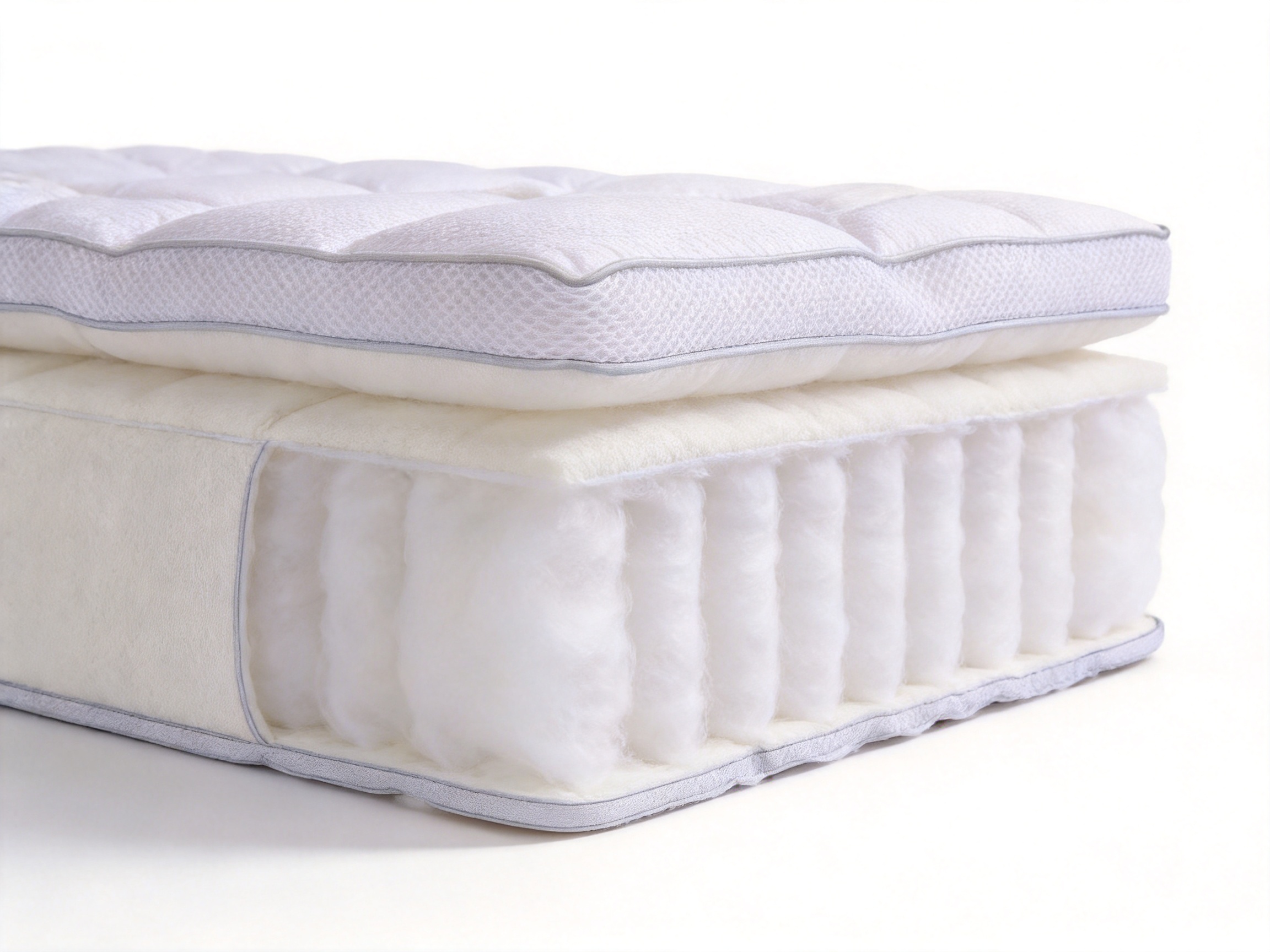
The production of a mattress topper requires coordination among several processes. Fabric must be checked and prepared before cutting. Filling must be measured and distributed consistently. The front, back, and interior layers must be aligned. Vertical design lines must be positioned accurately. Piping must be attached cleanly around the perimeter. Finally, the finished product must be inspected, folded, packed, and labeled according to the buyer’s requirements.
In a product with a knitted surface, handling control is especially important. Knitted fabrics can have stretch and directional characteristics that differ from woven fabrics. Cutting and sewing teams need to manage alignment and tension so that the finished surface remains attractive. Excessive stretching during sewing may affect the appearance of the vertical pattern or the edge. Careful production procedures help reduce these risks.
The filling process also requires attention. An 800gsm specification must be interpreted and controlled consistently across the product. Uneven filling can create thin zones, excessive thickness, or an irregular surface. Appropriate opening, blending, spreading, and inspection procedures help the manufacturer achieve a more even product. The quilting or vertical construction then helps secure the material in a repeatable form.
Piping requires both sewing accuracy and material coordination. The edge must be sufficiently neat to create a premium appearance, while the seam must be strong enough for ordinary handling. The front knitted fabric, rear brushed fabric, filling, and piping need to be assembled so that the perimeter remains smooth rather than puckered. These details are easy for customers to notice, particularly when the topper is viewed without a sheet.
Tongxiang Xinlong Bedding Co., Ltd. states that it has passed certifications and standards including ISO 9001, ISO 14001, OEKO-TEX Standard 100, OEKO-TEX STeP, GRS, and BSCI. These systems and certifications relate to different aspects of manufacturing, environmental management, textile safety, recycled material claims where applicable, and social responsibility. Buyers should confirm the current validity, scope, and product applicability of each certification during the purchasing process.
ISO 9001 is associated with quality management systems and process control. ISO 14001 concerns environmental management systems. OEKO-TEX Standard 100 addresses harmful substances in tested textile products, while OEKO-TEX STeP relates to sustainable textile and leather production facilities. GRS is relevant to products containing qualifying recycled materials and requires verification of applicable claims. BSCI is associated with social compliance auditing. Together, these credentials can provide an additional framework for evaluating the supplier, although product-specific inspection and documentation remain important for every order.
Quality Control Considerations
Quality control for the Knitted Fabric Mattress Topper should begin with incoming material inspection. The knitted fabric should be checked for color consistency, holes, stains, knitting defects, width variation, and unacceptable distortion. The brushed backing should be assessed for surface uniformity and damage. Filling should be verified against the agreed specification and examined for contamination, foreign matter, and irregular fiber distribution.
During cutting, measurements should be checked against the ordered size of 120 by 200 centimeters, with the buyer and manufacturer agreeing on tolerances in advance. The 4-centimeter height should be understood as an approximate finished height because textile loft can vary according to compression, measurement method, and time after unpacking. Clear measurement procedures help prevent disputes between supplier and buyer.
In-process inspection should examine alignment between the top fabric, backing, filling, vertical construction, and piping. Inspectors can review stitch density, seam security, skipped stitches, loose threads, edge shape, and pattern consistency. The topper should also be checked for filling migration or visible thin areas. Products that do not meet the agreed standard should be reworked or separated before final packing.
Final inspection may include visual review, measurement, weight checks, packaging checks, labeling verification, and carton quantity confirmation. For export orders, buyers may also specify testing for colorfastness, dimensional stability, flammability, seam performance, fiber composition, or restricted substances. The exact test program should reflect the destination market and the intended use of the product.
Packaging, Logistics, and Retail Presentation
A topper with a 4-centimeter loft can occupy more shipping volume than a thin mattress protector. Packaging therefore needs to balance protection, presentation, and logistics efficiency. The product may be folded or compressed according to the agreed packaging method, but compression should be evaluated carefully so that the knitted surface, piping, and filling can recover appropriately after unpacking.
Retail packaging should communicate the most important product benefits without making unsupported claims. Suitable information may include the product name, size, front and back fabric composition, filling specification, height, construction details, care instructions, country of origin, and applicable certification information. Buyers may also request packaging in multiple languages or with private-label branding.
For hospitality and contract projects, bulk packing may be more appropriate than individual retail packaging. In that case, protection against dust, moisture, abrasion, and compression during transport becomes especially important. Carton dimensions, pallet configuration, carton weight, and loading efficiency should be agreed during order planning.
The product’s visual details also make it suitable for photography and showroom presentation. A close view can reveal the knitted face, vertical design, and piping, while a full-bed image can demonstrate how the topper works within a complete bedding arrangement. Retailers should ensure that images represent the actual material and construction supplied, especially when color, texture, and height are key purchase factors.
Suitable Market Applications
The Knitted Fabric Mattress Topper can be sold through several channels. In home retail, it may appeal to consumers seeking a more comfortable bed without purchasing a new mattress. In furniture stores, it can be offered as an accessory with bed frames and mattresses. In online stores, its measurable specifications and visible construction features provide useful content for product comparison.
Hotels, serviced apartments, dormitories, and guesthouses may also consider this type of topper when they want to improve the feel of standardized mattresses. A consistent topper specification can help create a more uniform sleeping surface across rooms, subject to the operator’s cleaning, inspection, and replacement procedures. Hospitality buyers should evaluate the product’s care requirements, durability expectations, bed turnover, and laundering capacity before selecting it for large-scale use.
Interior furnishing companies can incorporate the product into complete bedroom packages. A package may include a mattress, topper, mattress cover, sheets, quilt, pillows, cushions, and blankets. The topper’s neutral design and refined surface make it suitable for coordinated presentation rather than isolated sale.
Wholesale distributors can position it between basic mattress protectors and premium natural-fiber or specialty foam toppers. Its polyester construction can help control cost and simplify sourcing, while the knitted surface and substantial filling offer a more elevated proposition than a minimal pad. This middle-market position may be especially useful for retailers serving customers who value comfort and appearance but remain price conscious.
Ordering and Customization Discussion
The supplied product specification identifies a 120 by 200 centimeter size. Buyers requiring other mattress dimensions should discuss development feasibility, minimum order quantities, fabric availability, filling requirements, sample approval, and production lead time with the manufacturer. Size changes may affect fabric consumption, quilting layout, edge construction, packaging, shipping volume, and final weight.
Color selection is another possible area for discussion. Knitted fabrics can be developed in different shades, but color matching should be managed through laboratory dips, fabric swatches, or approved standards. Buyers should clarify whether the required color is based on a physical reference, a standardized color system, or a digital image. Screen display is not a reliable substitute for physical approval.
Branding may be added through labels, packaging, hangtags, woven badges, printed care instructions, or customized cartons, subject to production capability and order volume. Any label should accurately identify fiber content, size, care information, and responsible business details required by the destination market.
Buyers should request a pre-production sample when the product is intended for a new collection or large order. The sample should be assessed for surface hand feel, loft, weight, stitching, piping, dimensions, appearance after unpacking, and compatibility with the intended fitted sheet. Approval should be documented before bulk manufacturing begins.
Care and Use Guidance
Care instructions should be confirmed with the supplier before publication because the correct method depends on the fabric, filling, stitching, packaging, and final product testing. In general, customers should follow the sewn-in label and avoid care methods that exceed the stated temperature, mechanical action, or drying conditions.
The topper should be placed evenly over the mattress and covered with a suitable fitted sheet. The fitted sheet should have enough depth to accommodate the mattress and the additional approximately 4-centimeter layer. If the sheet is too shallow, it may pull away from the corners or compress the topper unevenly.
Regular airing can help refresh the product, while excessive exposure to direct sunlight may affect some textile colors over time. The topper should be stored clean and completely dry. If it is compressed for storage or transport, it should be allowed to recover according to the supplier’s instructions before being evaluated for loft and appearance.
Because the product is not specified as waterproof, users who require liquid protection should combine it with a suitable waterproof mattress protector. This layered approach allows the knitted topper to perform its comfort and aesthetic functions while a separate barrier handles moisture protection.
Comparison of Product Positions
Product type |
Primary purpose |
Typical construction character |
Position of the knitted fabric topper |
Thin mattress protector |
Basic surface protection |
Lightweight and low profile |
Provides a fuller comfort layer and more visible design |
Waterproof mattress cover |
Liquid barrier protection |
Often includes an impermeable membrane |
Should be used separately if waterproofing is required |
Loose quilt placed under a sheet |
Additional warmth or softness |
May have less controlled positioning |
Offers a dedicated topper format with vertical design and piping |
Foam mattress topper |
Pressure and firmness modification |
Solid foam structure |
Uses textile filling and may be easier to integrate into textile bedding collections |
Knitted fabric mattress topper |
Comfort, softness, appearance, and textile layering |
Knitted face, brushed backing, polyester filling |
Balanced option for home textile and contract bedding programs |
This comparison demonstrates why product positioning should be precise. The topper is not intended to replace every type of mattress accessory. Its strength lies in combining a noticeable comfort layer with a refined textile appearance and scalable polyester manufacturing.
Why Polyester Is a Practical Material Choice
Polyester remains one of the most widely used fibers in home textiles because it offers a combination of availability, process consistency, durability, and design flexibility. It can be knitted into soft surface fabrics, brushed for a gentler backing, and processed into resilient filling fibers. These different forms of the same broad fiber family allow the manufacturer to build a multi-layer product with coordinated material behavior.
For large orders, polyester can also support stable sourcing and repeatability. Natural fibers may vary according to harvest, region, and processing conditions, while synthetic fibers can often be specified with more controlled technical characteristics. This does not make polyester automatically superior in every category, but it can make it appropriate for buyers who prioritize consistent production, practical care, and controlled cost.
The 6D polyester filling is especially suitable for a product that must maintain a soft, lofty appearance during repeated handling. Its performance will depend on the fiber quality, opening process, quilting pattern, and care conditions, so responsible buyers should evaluate samples and test results rather than relying on the fiber name alone.
The use of polyester also makes the topper accessible to a broad market. It can be presented as a practical alternative for consumers who want a soft bedding layer without choosing down or other animal-derived fillings. Retailers should nevertheless describe the product accurately and avoid claiming specific hypoallergenic, antimicrobial, cooling, or therapeutic performance unless those characteristics have been verified through appropriate testing.
Sustainability and Responsible Production
Sustainability in home textiles includes raw materials, energy use, water management, chemical control, waste reduction, packaging, working conditions, product lifespan, and end-of-life considerations. The company’s stated ISO 14001, OEKO-TEX STeP, GRS, and BSCI credentials indicate that environmental and social management are part of its broader manufacturing framework. Buyers should confirm the current certificates and their scope before using them in marketing materials.
The supplied specification does not state that this particular topper is made from recycled polyester. Therefore, recycled content should not be claimed unless it is documented for the ordered product. If a buyer requests recycled filling or recycled face fabric, the material source, percentage, certification, transaction documentation, and labeling requirements should be agreed before production.
Product durability is also part of responsible consumption. A topper that retains an attractive appearance and useful comfort over a reasonable service period can reduce the pressure to replace bedding too frequently. Proper filling distribution, edge finishing, fabric quality, and care instructions all influence this outcome. The best sustainability claims are supported by traceable documentation and realistic product-use guidance.
Quality, Innovation, and Customer Service
The company states that quality is treated as the life of the enterprise and that it standardizes operating procedures while improving employee technical skills. This approach is relevant to bedding products because small production variations can have a visible impact. A difference in filling distribution, edge shape, fabric tension, or piping quality may affect the customer’s perception even when the product specification appears unchanged.
Technical personnel are important in the development of bedding products with multiple layers. They can help assess whether a selected fabric works with a particular filling, whether a design remains stable after quilting, and whether packaging affects recovery. They can also support adjustments for different markets, such as alternate sizes, labels, colors, carton configurations, or testing requirements.
Customer service is particularly important for overseas buyers. Clear communication should cover sample timing, material approvals, production schedules, inspection arrangements, shipping documents, packing methods, and after-sales procedures. A supplier with experience across quilts, pillows, cushions, blankets, bedspreads, and protectors may be able to address these needs in the context of a broader home textile program.
The company’s location in Zhejiang Province places it within a major Chinese manufacturing region with access to textile materials, labor, transport networks, and export infrastructure. Geographic advantages do not replace quality control, but they can support efficient coordination of fabric sourcing, production, warehousing, and shipment.
Frequently Asked Questions
What is the main function of this mattress topper?
Its main function is to add a soft, fuller textile layer above the mattress while contributing to a neat and refined bed presentation. It is described as a polyester mattress protector or bed spread and includes an approximately 4-centimeter construction with 800gsm 6D polyester filling.
What size is specified for the product?
The supplied specification lists a size of 120 by 200 centimeters. Buyers who need different dimensions should discuss customization, minimum order quantities, material usage, and production requirements with the manufacturer.
What materials are used on the front and back?
The front uses 250gsm polyester knitted fabric. The back uses 80gsm brushed fabric. The interior uses 800gsm 6D polyester filling.
Does the product provide waterproof protection?
No waterproof membrane is identified in the supplied specifications. The product should therefore be marketed as a comfort-oriented mattress topper and textile protector, not as a waterproof mattress encasement. A separate waterproof cover can be used when liquid protection is needed.
What makes the knitted surface different from a basic polyester cover?
The knitted structure provides a distinctive hand feel and a fuller visual appearance. It also gives the product a more contemporary and premium character than a plain, lightweight cover. The final feel depends on the yarn, knitting process, finishing, and manufacturing quality.
What is the purpose of the vertical design?
The vertical design provides a clean visual pattern and supports an orderly construction. It contributes to the product’s breathable design language and helps distinguish the topper from a flat, undecorated pad.
Why is piping used around the edge?
Piping defines the perimeter, improves the finished appearance, and creates a more tailored look. It can also help the edge appear more structured when the product is displayed or placed beneath a fitted sheet.
Is the topper suitable for hotels or guest accommodation?
It may be suitable for hotels, guesthouses, serviced apartments, and other accommodation projects that want an additional comfort layer. Project buyers should first confirm cleaning procedures, care requirements, durability expectations, bed dimensions, and the required inspection standards.
Can the topper be combined with other bedding products?
Yes. It can be combined with a waterproof mattress protector, fitted sheet, quilt, duvet, blanket, pillows, cushions, or bedspread. Its structured appearance makes it suitable for coordinated home textile collections.
Can private-label packaging be requested?
Private-label options may be discussed with the manufacturer. Buyers should confirm minimum quantities, label formats, packaging materials, artwork requirements, carton specifications, and approval procedures before placing an order.
Are other colors or sizes available?
The supplied information confirms only the 120 by 200 centimeter size and does not list a color range. Other colors or sizes may be possible depending on fabric availability, order volume, development requirements, and production planning. Confirmation should be obtained directly from the supplier.
What should buyers inspect before approving a bulk order?
Buyers should review fabric hand feel, color, dimensions, height, filling distribution, stitching, piping, edge shape, surface appearance, packaging, labels, and recovery after unpacking. Any required testing or certification should also be confirmed for the specific production order.
Recommended Buyer Evaluation Checklist
Before purchasing, buyers should confirm the intended mattress size and whether the 120 by 200 centimeter specification matches the target market. They should also evaluate the topper’s height in relation to the fitted sheet and bed frame. A sample placed on the intended mattress is more informative than reviewing measurements alone.
The surface should be checked under natural and indoor lighting. The knitted face should have a consistent appearance without obvious holes, stains, pulled yarns, or irregular tension. The vertical lines should be visually orderly, and the piping should follow the edge without excessive waviness or loose threads.
The interior should be assessed by touch and, where appropriate, by weighing a sample or using agreed inspection methods. The topper should feel reasonably consistent from one area to another. Buyers should discuss acceptable tolerance levels for weight, size, thickness, and filling distribution with the manufacturer.
Packaging should be opened and inspected after the product has been transported or compressed. This allows the buyer to understand how quickly the topper recovers, whether the face fabric creases excessively, and whether the piping retains its shape. Care instructions should be reviewed at the same time.
Finally, buyers should ensure that all marketing claims match the product documentation. Claims about waterproofing, recycled content, antimicrobial treatment, allergy suitability, cooling performance, organic fibers, or medical benefits should be made only when supported by verified specifications and testing.
Conclusion
The Knitted Fabric Mattress Topper is a balanced home textile product that combines a premium-looking surface with substantial polyester filling and a practical layered construction. Its 250gsm knitted face provides softness and visual depth. Its 80gsm brushed backing contributes to a comfortable reverse finish. Its 800gsm 6D polyester filling adds loft and cushioning, while the approximately 4-centimeter height gives the topper a noticeable presence on the bed.
The breathable vertical design and decorative piping help separate it from plain, low-profile mattress protectors. At the same time, its textile construction offers a different product experience from solid foam toppers or loose quilts. It can be positioned for residential retail, hospitality, furniture accessories, contract furnishing, and coordinated home textile collections.
The manufacturing strength behind the product is supported by the supplier’s experience in quilts, pillows, cushions, blankets, bedspreads, mattress protectors, and related bedding products. The stated production scale, technical personnel, equipment, quality procedures, and international certifications provide a foundation for professional sourcing. Buyers should still conduct product-specific sampling, inspection, and documentation review, particularly when purchasing for regulated markets or high-volume projects.
For customers seeking an improved bed surface with a soft hand feel, orderly construction, and refined appearance, this mattress topper offers a practical and attractive solution. For distributors and brands, it provides a clear combination of measurable specifications, visible differentiation, and compatibility with a broader home bedding program.
References
1. Supplied product specification for the Knitted Fabric Mattress Topper, including dimensions, fabrics, filling, construction details, and product category.
2. Supplied company information for Tongxiang Xinlong Bedding Co., Ltd., including manufacturing history, facility scale, product range, equipment, workforce, and quality objectives.
3. ISO 9001 quality management system principles and process-control guidance.
4. ISO 14001 environmental management system principles and environmental improvement guidance.
5. OEKO-TEX Standard 100 framework for testing textiles for harmful substances.
6. OEKO-TEX STeP principles for sustainable textile and leather production facilities.
7. Global Recycled Standard principles for recycled material content and chain-of-custody verification.
8. Business Social Compliance Initiative principles for social responsibility and supply-chain assessment.
9. General textile manufacturing and bedding quality-control practices concerning fabric inspection, filling distribution, sewing, piping, packaging, and final product evaluation.


 +86-573-88798028