



 Français
 Español
 Deutsch
Content
- 1 Designed for Deep Winter Comfort
- 2 Premium Cotton Surface for Daily Contact
- 3 Construction and Product Specifications
- 4 Why the Fitted Skirt Matters
- 5 Advantages Over Lightweight Mattress Protectors
- 6 Advantages Over Low-Loft or Poorly Filled Toppers
- 7 Manufacturing Expertise Behind the Product
- 8 Professional Production Process
- 9 Quality, Certification, and Responsible Production
- 10 Suitable Applications for Different Customers
- 11 Comfort Benefits for Different Sleep Preferences
- 12 Care and Long-Term Use
- 13 Why Factory Capability Matters to Buyers
- 14 Competitive Positioning
- 15 Purchasing Considerations for Importers and Distributors
- 16 Frequently Asked Questions
- 16.1 What is the main purpose of this mattress topper?
- 16.2 What materials are used in the product?
- 16.3 What size is available in the stated specification?
- 16.4 Is this product a mattress protector or a mattress topper?
- 16.5 Is it suitable for winter use?
- 16.6 Will the topper move during sleep?
- 16.7 Can it make a firm mattress feel softer?
- 16.8 Is cotton better than synthetic fabric for the entire topper?
- 16.9 Can the topper be used in hotels or guest rooms?
- 16.10 How should the product be cleaned?
- 16.11 What should buyers verify before placing a bulk order?
- 16.12 What makes the manufacturer suitable for this product?
- 17 Conclusion
- 18 References
- 19 Product: Luxurious and Comfortable Cotton Mattress Topper
A mattress can provide the structural support needed for sleep, but it does not always provide the softness, warmth, and surface comfort that every sleeper wants. A well-designed mattress topper can transform the sleeping environment by adding a comfortable cushioning layer, helping regulate the feel of the bed, and protecting the mattress from daily wear. The Luxurious and Comfortable Cotton Mattress Topper is designed for customers who want a substantial, warm, and comfortable bedding layer made with carefully selected materials and supported by professional home textile manufacturing expertise.
This premium cotton mattress protector combines a 233-thread-count cotton surface, a substantial 800 grams per square meter polyester ballfibre filling, and a flexible 90 grams per square meter polyester stretch-fabric skirt. Its generous 160 by 200 centimeter size, together with a 30-centimeter fitted depth, allows it to cover a broad range of standard mattress configurations while remaining securely positioned during use.
Unlike a thin mattress cover that focuses mainly on basic surface protection, this product is developed as a thick mattress topper for enhanced warmth and softness. The lofty filling creates a cushioned sleeping surface that feels fuller and more comfortable, particularly during cold winter conditions. At the same time, the cotton fabric offers a smooth, breathable, and pleasant touch that is suitable for everyday use in homes, guest rooms, hospitality settings, and furnished accommodation.
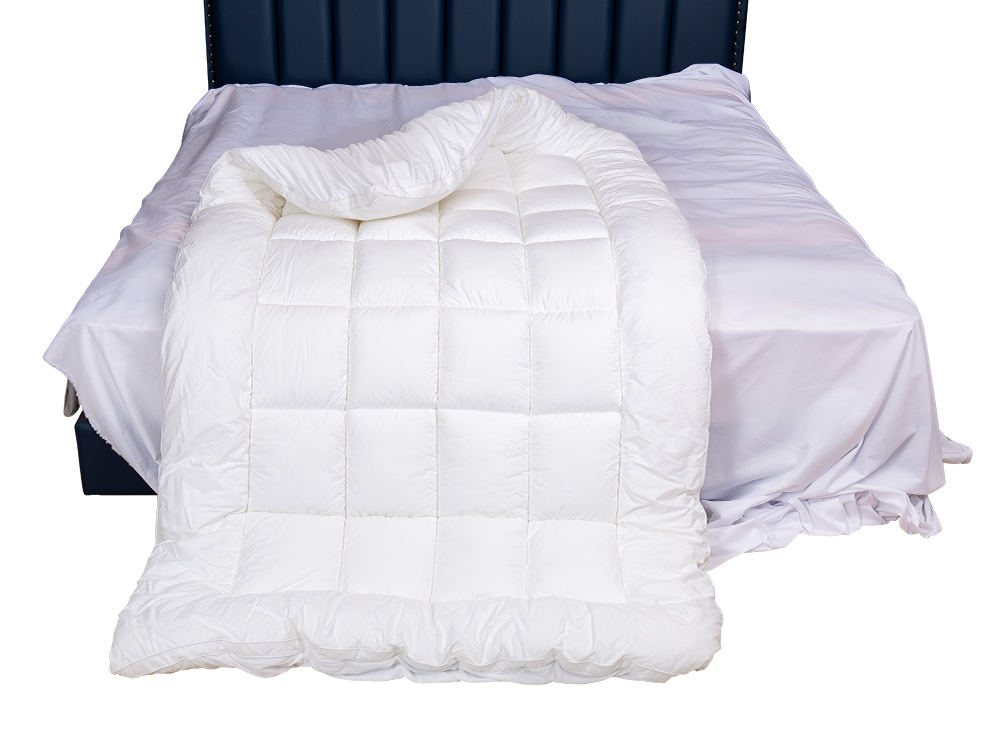
Luxurious and Comfortable Cotton Mattress Topper
Designed for Deep Winter Comfort
Cold weather changes the way people experience their bedrooms. A mattress that feels comfortable in mild weather may seem hard or uninviting during winter. Thin bedding layers may not provide enough insulation, while ordinary mattress protectors may offer protection without adding meaningful warmth. This thick cotton mattress topper addresses that gap by combining a soft natural-feel surface with a high-loft synthetic filling.
The 800 grams per square meter polyester ballfibre filling is the central feature of the design. Ballfibre is formed into resilient clusters that create loft and volume throughout the topper. When distributed correctly, these fibers create a cushion-like layer between the sleeper and the mattress. The resulting surface feels fuller than a standard quilted cover and can help reduce the sensation of a firm or unyielding mattress.
The high filling weight also contributes to thermal comfort. The lofted fibers create small air spaces within the topper. These spaces help slow the movement of heat away from the body, allowing the product to feel warmer than a lightweight mattress protector. Although individual warmth preferences differ, the combination of a thick construction and high-density filling makes this topper especially suitable for winter bedrooms, cool climates, and sleepers who prefer a cozy bed.
Warmth is not the only benefit of a thick construction. The additional layer can soften the transition between the body and the mattress, making the bed feel more inviting at bedtime. It may be particularly useful when a mattress is structurally sound but feels too firm on its own. Rather than replacing an entire mattress, users can adjust the surface experience with a purpose-built topper.
Premium Cotton Surface for Daily Contact
The surface fabric is made from 233-thread-count cotton. Because the surface of a mattress topper remains in close contact with sheets and bedding, fabric selection is important. Cotton is widely valued in home textiles for its natural hand feel, familiar comfort, and ability to provide a pleasant sleeping surface throughout the night.
A 233-thread-count construction offers a balanced textile experience. It is substantial enough to provide a smooth and refined appearance while remaining suitable for comfortable bedding use. The fabric is not selected merely for visual appeal. It also supports a soft touch, consistent surface coverage, and a more finished product impression than a basic, loosely constructed mattress pad.
When people move in bed, the topper surface is exposed to repeated friction from sheets, pajamas, and normal body movement. A well-constructed cotton fabric helps the topper maintain a comfortable contact layer during regular use. Its familiar natural feel can also make the bed seem more breathable and less synthetic than products made entirely from man-made surface fabrics.
The cotton cover is complemented by the polyester filling rather than treated as a competing material. Cotton contributes surface comfort and a natural textile touch, while polyester ballfibre contributes loft, resilience, warmth, and ease of product construction. This material combination allows the topper to deliver a practical balance between comfort and performance.
For customers purchasing bedding in volume, the cotton surface also offers broad market appeal. Cotton remains an established choice for residential bedding, hotels, rental properties, dormitories, and guest accommodations. Its recognizable material identity makes the product easier to position as a premium comfort layer instead of an ordinary protective sheet.
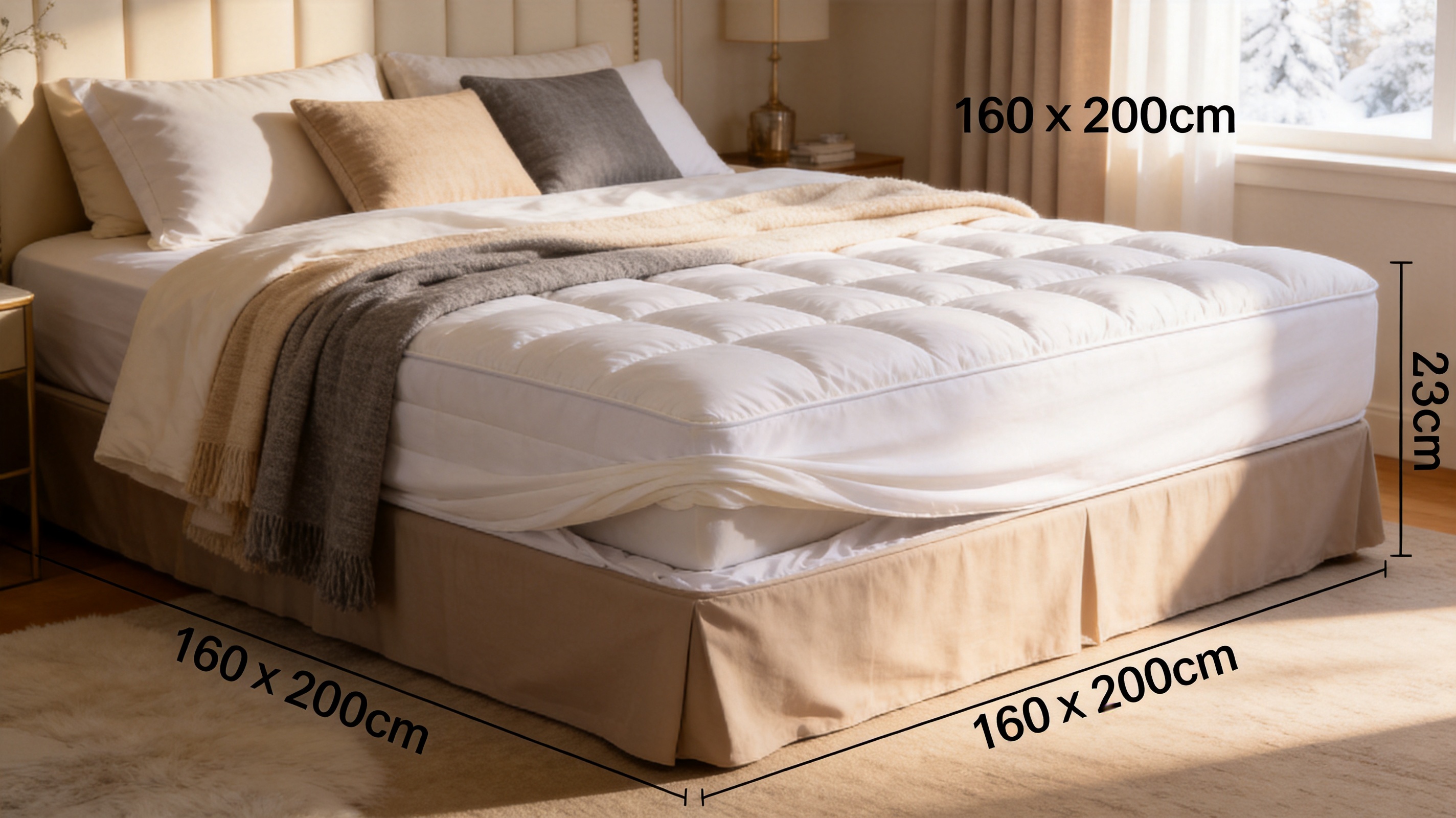
Construction and Product Specifications
The product is engineered with several layers and components that work together. The surface provides the primary touch experience, the filling creates loft and warmth, and the skirt helps keep the topper in place around the mattress. Each component has a specific purpose, and the combination gives the product a more complete function than a simple flat quilt.
Product category |
Premium cotton mattress protector and thick mattress topper |
Product size |
160 x 200 centimeters with a 30-centimeter fitted depth |
Surface fabric |
233-thread-count cotton fabric |
Skirt fabric |
90 grams per square meter polyester stretch fabric |
Filling |
800 grams per square meter polyester ballfibre |
Primary purpose |
Added warmth, cushioning, surface comfort, and mattress coverage |
Recommended seasonal use |
Especially suitable for autumn and winter, with year-round use depending on climate and preference |
The 160 by 200 centimeter body size is suitable for a broad double-bed format. The additional 30-centimeter depth is important because a topper must extend beyond the upper surface of the mattress if it is to remain secure. A shallow design may shift during sleep or fail to cover the mattress sides adequately. The fitted depth gives the product more flexibility when used with thicker mattresses.
The 90 grams per square meter polyester stretch fabric used for the skirt supports a close fit. Stretch fabric can adapt to the contours of the mattress and help the topper remain in position as sleepers turn or adjust their posture. This is a meaningful advantage over loose flat mattress pads, which may require frequent repositioning.
Why the Fitted Skirt Matters
A mattress topper can be soft and warm, but those qualities are less valuable if the product moves excessively during the night. Shifting can create wrinkles, uneven cushioning, and uncomfortable ridges beneath the body. It can also make bed making more difficult. The fitted skirt is therefore an important functional component rather than a decorative addition.
The elastic character of the 90 grams per square meter polyester stretch fabric allows the skirt to accommodate mattress edges. Once the topper is placed over the bed, the skirt can extend down the sides and help hold the main panel in a stable position. This construction is especially useful for active sleepers, family bedrooms, and guest rooms where reliable bed presentation is important.
Compared with a flat cover, a fitted topper can reduce the need for manual adjustment. Users can place it on the mattress, pull the skirt into position, and cover it with a fitted sheet. When correctly fitted, the topper becomes part of the bed rather than a separate layer that repeatedly slides toward the center.
The fitted depth also makes the product more adaptable. Mattress profiles vary significantly between manufacturers and models. A 30-centimeter skirt depth provides additional coverage for many thicker mattress designs, pillow-top mattresses, and mattresses paired with other low-profile comfort layers. The exact fit should always be confirmed against the mattress dimensions before purchase, but the design offers more flexibility than a shallow mattress protector.
Advantages Over Lightweight Mattress Protectors
Many mattress protectors are designed primarily to defend the mattress against dust, minor spills, and everyday contact. Their construction may be thin, flat, and easy to fold. That approach is suitable when protection is the only requirement, but it may not meet the needs of users who want a warmer and softer sleeping surface.
This cotton mattress topper occupies a different position in the bedding market. It provides protective coverage while also adding substantial volume. The 800 grams per square meter filling gives the product a distinctly fuller feel than a simple cover. Customers who find thin protectors too insubstantial may appreciate the added cushioning and thermal comfort.
The product also offers an alternative to purchasing a new mattress solely because the existing surface feels too firm. A mattress topper cannot correct every structural problem, and it should not be used to replace a damaged or unsupportive mattress. However, when the underlying mattress is in good condition but lacks softness or warmth, adding a thick topper can be a practical way to improve the sleep surface.
Another advantage is the combination of cotton and polyester. Some low-cost products use a single material throughout, which can limit either surface comfort or loft. Here, cotton is used where the hand feel matters most, while polyester is used for the skirt and filling where stretch, resilience, and structural consistency are important. This targeted use of materials supports a more balanced product specification.
The topper is also more visually substantial than many minimal mattress pads. A fuller surface can create a comfortable, layered bed presentation under sheets and blankets. For hotels, furnished apartments, and retailers, the product can be positioned as an upgrade item that improves perceived comfort without requiring a complete change to the bed system.
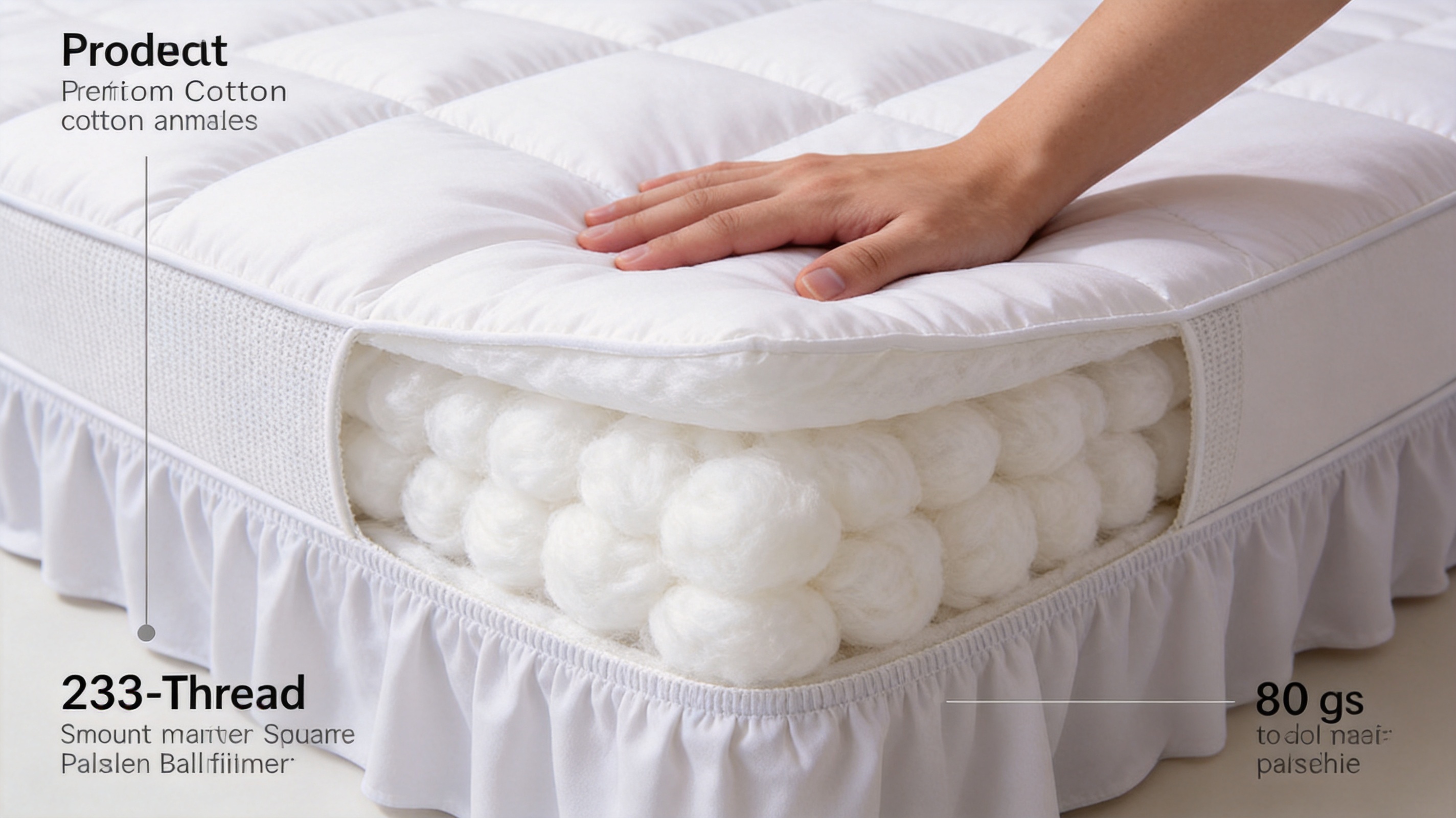
Advantages Over Low-Loft or Poorly Filled Toppers
Not every thick-looking mattress topper delivers consistent comfort. Some products use a low filling weight, uneven fiber distribution, or weak stitching that allows the filling to migrate. These issues can create thin areas, cold spots, or an inconsistent sleeping surface. Product specifications and manufacturing control are therefore essential.
The stated 800 grams per square meter filling weight demonstrates that this topper is developed for substantial warmth rather than minimal padding. A heavier filling can create a more generous loft and a fuller hand feel. It also gives the product a stronger winter-oriented identity than lightweight models marketed for basic protection.
Polyester ballfibre is useful in this application because it can be distributed across the topper to create a soft, resilient structure. The fibers are designed to recover volume after compression, helping the product remain comfortable through repeated use. Proper quilting, filling distribution, edge construction, and finishing are all necessary to make the most of this material.
A professional bedding factory can control these stages more effectively than a supplier that treats mattress toppers as a secondary product. Experienced production teams understand how fabric weight, filling volume, stitching density, edge binding, skirt attachment, and final inspection affect the finished article. This manufacturing knowledge is one of the product’s key competitive strengths.
Manufacturing Expertise Behind the Product
Tongxiang Xinlong Bedding Co., Ltd. was established in January 2002 and specializes in a broad range of home textile products. Its product portfolio includes silk cotton quilts, chemical fiber quilts, pillows, cushions, bedspreads, travel quilts, mattress protectors, blankets, quilt and pillowcases, shower curtains, and curtains. This category experience is relevant because a manufacturer that produces multiple forms of bedding can apply knowledge from one product group to another.
The company operates in Longxiang Industrial Park, Wuzhen Town, in Zhejiang Province, China. According to the supplied company information, its facilities cover approximately 21,000 square meters, including a construction area of approximately 18,000 square meters. More than 320 employees support production and related operations, and the company is equipped with a range of advanced manufacturing equipment.
Scale matters in home textile production. A factory with established facilities can organize fabric preparation, cutting, filling, sewing, quilting, skirt attachment, inspection, packing, and shipment in a coordinated manner. This can improve production consistency and support larger customer orders. It also gives the manufacturer a stronger base for repeated production, which is important for wholesalers and retailers that need dependable replenishment.
The company’s experience since 2002 also provides a long operating history in a competitive industry. Home textile products must satisfy both aesthetic and technical expectations. Customers look for attractive fabrics and comfortable hand feel, but they also expect reliable dimensions, secure stitching, stable filling, and practical packaging. Long-term production experience helps a manufacturer understand these requirements as part of a complete product system.
Professional Production Process
Material Selection and Incoming Inspection
Manufacturing begins with the selection of suitable fabrics, filling fibers, elastic materials, thread, labels, and packaging components. For this topper, the main material requirements include a 233-thread-count cotton fabric, 800 grams per square meter polyester ballfibre, and 90 grams per square meter polyester stretch fabric for the skirt.
Incoming inspection helps confirm that materials meet the required specifications before they enter production. Fabric width, color, weight, surface condition, and dimensional stability can be reviewed. Filling materials can be checked for cleanliness, consistency, resilience, and distribution characteristics. Stretch fabric requires particular attention because its elasticity affects the finished fit around the mattress.
Fabric Preparation and Cutting
After inspection, fabric is prepared for cutting. Accurate cutting is important because the finished topper must match its specified size and maintain an even relationship between the top panel, filling, and skirt. Poor cutting can result in uneven edges, insufficient coverage, or difficulty attaching the fitted skirt.
Professional cutting equipment and experienced operators help reduce material waste while maintaining repeatable dimensions. For larger production runs, standardized cutting procedures also help ensure that products from different batches remain consistent. This consistency benefits customers who sell the topper through retail channels or use it across multiple properties.
Filling Preparation and Layer Formation
The polyester ballfibre is prepared for even placement within the topper. The goal is to create a consistent layer that provides comparable loft across the sleeping surface. If filling is concentrated in some sections and sparse in others, the user may feel uneven support and warmth.
Controlled filling procedures help maintain the specified weight and appearance. The filling must be spread across the prepared fabric panels before the layers are joined. Depending on the production design, temporary holding methods and quilting patterns can be used to reduce movement during sewing.
Quilting and Secure Stitching
Quilting is an important stage because it connects the surface fabric, filling, and backing structure. Appropriate quilting helps keep the filling in place and gives the topper its finished appearance. Stitching must be secure enough to withstand handling, washing according to care instructions, folding, packing, and normal nighttime movement.
Quilting also influences the balance between loft and stability. Stitching that is too sparse may allow filling migration, while stitching that is too dense may compress the filling and reduce softness. Experienced bedding manufacturers select production settings that support the intended product character: thick, warm, comfortable, and practical.
Skirt Attachment
The fitted skirt is attached around the main topper panel. This stage requires careful alignment because the skirt must extend evenly around the product and maintain its intended depth. The connection should be strong and neat, with reinforced stitching in areas exposed to pulling during installation.
The stretch characteristics of the polyester skirt are considered during sewing. The fabric must retain sufficient flexibility to fit around mattress corners without excessive strain. At the same time, it should not be so loose that the topper becomes unstable. Balanced tension and accurate assembly are essential to achieving a secure fit.
Finishing and Inspection
Finished products are checked for loose threads, uneven seams, filling irregularities, fabric defects, dimensional variation, and overall appearance. Inspection may take place at several points rather than only at the end of production. Early checks allow problems to be corrected before additional labor and materials are invested.
Final inspection is particularly important for products supplied to international customers. Export buyers may require consistent measurements, clean finishing, reliable packing, accurate labeling, and conformity with agreed specifications. A systematic quality process helps reduce avoidable problems during delivery and retail handling.
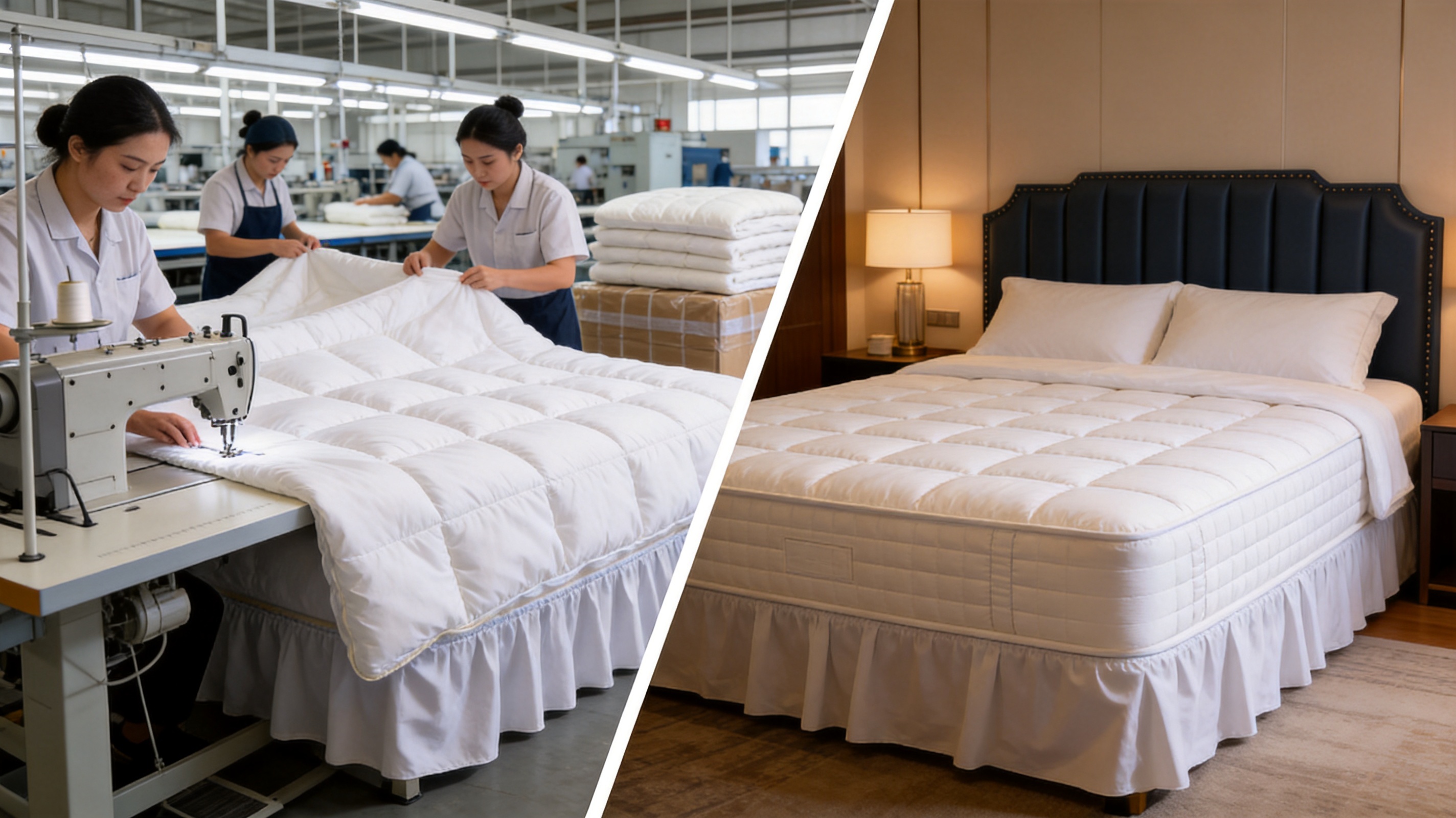
Quality, Certification, and Responsible Production
The company states that it has passed international certifications and management or product-related standards including ISO 9001, ISO 14001, OEKO-TEX Standard 100, OEKO-TEX STeP, GRS, and BSCI. These certifications represent different areas of organizational, environmental, product safety, recycled-material, or social-compliance performance. The exact scope and validity of any certification should be confirmed for the relevant factory, product, and production period.
ISO 9001 is associated with quality management systems. In a bedding factory, a quality management approach can support documented procedures, responsibility assignment, process monitoring, corrective action, and continuous improvement. These practices are valuable when producing items that must remain consistent across multiple orders.
ISO 14001 relates to environmental management systems. Home textile manufacturing involves fabric use, fiber handling, energy consumption, packaging, and waste management. An environmental management framework encourages a factory to identify relevant impacts and establish procedures for improvement.
OEKO-TEX Standard 100 is widely recognized in the textile sector for testing textiles and components for certain harmful substances. OEKO-TEX STeP addresses sustainable textile and leather production facilities. GRS is associated with recycled materials and chain-of-custody requirements when applicable. BSCI is connected with social compliance and responsible working conditions within supply chains.
These certifications do not replace product-specific inspection, but they provide useful evidence of a manufacturer’s broader commitment to controlled operations. For importers and professional buyers, this can simplify supplier evaluation and provide a starting point for compliance discussions.
The supplied company information also states that the factory has been rated as a safety production standardization enterprise for several consecutive years since 2016. Workplace safety is important in a production environment containing cutting equipment, sewing machines, filling equipment, packaging machinery, and material-handling systems. Safer operations support employee welfare and can also improve production continuity.
Suitable Applications for Different Customers
Residential Bedrooms
For household use, the topper can add warmth and softness to a main bedroom, children’s room, or guest room. It is especially appropriate for families preparing for colder seasons. Users who enjoy a plush sleeping surface may place it beneath a fitted sheet to create a more comfortable bed environment.
Guest Accommodation
Guest rooms benefit from bedding that looks substantial and feels welcoming. A thick cotton mattress topper can help create a more comfortable presentation without replacing the underlying mattress. Its fitted design may also reduce movement during use, which can make room turnover and bed preparation more convenient.
Hotels and Serviced Apartments
Hospitality businesses often need bedding products that combine comfort, appearance, repeatability, and supply reliability. This topper can serve as an additional comfort layer in colder seasons or in rooms where mattresses require a softer surface. The manufacturer’s broader bedding experience may also make it easier for commercial buyers to coordinate related products such as pillows, quilts, blankets, bedspreads, and mattress protectors.
Furnished Rentals
Furnished apartments and rental properties require practical bedding solutions that improve the guest experience while helping preserve mattresses. A topper can create a more finished bed package and provide an additional layer between sleepers and the mattress. Property operators should establish suitable cleaning and replacement schedules based on occupancy, climate, and care instructions.
Retail and Wholesale Distribution
Retailers can position this item as a premium seasonal comfort product. Its clear material specifications, substantial filling weight, cotton surface, fitted skirt, and winter-oriented design provide several selling points for product listings and in-store displays. Wholesalers can also include it in a broader bedding assortment that covers pillows, quilts, blankets, cushions, and other home textile categories.
Comfort Benefits for Different Sleep Preferences
Sleep comfort is subjective, but the topper’s thick construction is likely to appeal to people who prefer a cushioned and cozy surface. Side sleepers may appreciate the additional softness because the topper can reduce the immediate feel of a firm mattress beneath pressure points. Back sleepers may enjoy the smoother transition between the body and the mattress, provided that the underlying mattress already offers appropriate support.
People who sleep cold may find the high-loft filling especially useful. The product is designed with a high warmth coefficient in mind, making it a natural choice for winter use. In warmer environments, users may decide to remove the topper seasonally or pair it with lightweight, breathable sheets.
The topper can also be useful for people who want to adjust an existing mattress without making a permanent change. A mattress purchase is a significant investment, and the surface feel may not be perfect for every household member. A removable topper provides a flexible way to customize the bed’s softness and warmth.
It is important to distinguish surface comfort from mattress support. A topper can change the feel of the upper layer, but it cannot replace the structural support of a suitable mattress. If a mattress is sagging, damaged, or unsuitable for the sleeper’s body, professional assessment or replacement may be necessary.
Care and Long-Term Use
Proper care helps preserve the appearance and loft of any thick bedding product. Users should follow the care label and the seller’s washing instructions because cleaning requirements may depend on the final construction, quilting pattern, equipment capacity, and packaging specifications.
Regular airing can help maintain freshness. When possible, the topper should be removed from the bed, gently shaken, and allowed to breathe in a clean, dry environment. Prolonged exposure to intense direct sunlight or excessive moisture should be avoided unless specifically permitted by the care instructions.
When washing is allowed, the product should be handled according to its size and filling volume. An oversized topper may require a large-capacity commercial machine rather than a standard household washer. Complete drying is important because residual moisture inside a thick filling layer can affect freshness and fabric condition.
Users should avoid placing sharp objects on the topper and should take care when pulling the skirt over mattress corners. Although the stretch fabric is designed to support fitting, excessive force can place unnecessary stress on seams. A gentle, even installation method can help preserve the skirt and attachment points.
Using a fitted sheet over the topper can provide an additional layer of everyday protection. The sheet should be large enough to accommodate both the mattress and topper without compressing the product excessively. Excessive compression may reduce the loft and interfere with the fitted skirt.
Why Factory Capability Matters to Buyers
Product quality is influenced not only by the materials listed on a specification sheet but also by the factory’s ability to process those materials correctly. Cotton fabric, polyester filling, and stretch skirt fabric each require different handling considerations. A supplier must understand how to combine them without compromising comfort, fit, or durability.
A manufacturer with an established product range can support customers beyond a single item. Buyers may need coordinated bedding collections, private-label development, packaging adjustments, size variations, or seasonal product programs. Experience with quilts, pillows, blankets, cushions, bedspreads, and mattress covers provides a practical foundation for these discussions.
The company’s stated facility size and workforce indicate an organization capable of supporting structured production rather than small-scale informal assembly. Advanced equipment can improve cutting accuracy, filling distribution, quilting consistency, and sewing efficiency. Professional technical personnel can also contribute to design refinement and production problem solving.
Continuous development is particularly important in home textiles because consumers expect products to combine comfort, attractive presentation, safety, and practical care. The company states that it continues to develop and innovate in response to changing industry requirements. For buyers, this suggests a supplier orientation that is not limited to reproducing basic products but can also support improvements in materials, construction, and product positioning.
Competitive Positioning
The Luxurious and Comfortable Cotton Mattress Topper can be positioned between a conventional mattress protector and a very soft decorative bed layer. It provides more padding and warmth than a thin protector while maintaining a practical fitted design. Its cotton surface gives it a premium material story, and its high filling weight reinforces the product’s winter comfort message.
Several features distinguish it in a crowded bedding market:
First, the 800 grams per square meter polyester ballfibre filling gives the topper a substantial construction. Customers looking for a warm, thick, cushion-like layer are more likely to notice this difference than they would with a lightweight product.
Second, the 233-thread-count cotton surface provides a refined and familiar touch. This supports a premium presentation and makes the product suitable for customers who prefer cotton bedding.
Third, the 30-centimeter fitted depth and stretch-fabric skirt support secure placement. This is a functional benefit that flat pads and shallow covers may not provide to the same extent.
Fourth, the product is manufactured by a company with long-term experience across multiple home textile categories. This broad specialization can support quality control, coordinated sourcing, and future product development.
Finally, the stated certifications and factory management systems provide additional confidence for professional buyers evaluating quality, environmental practices, product safety, and social responsibility. Buyers should still verify current documentation, but the company’s certification portfolio is a useful part of its supplier profile.
Purchasing Considerations for Importers and Distributors
Before placing an order, buyers should confirm the target market’s preferred bed size, mattress depth, color, packaging format, labeling requirements, and care instructions. The supplied specification is 160 by 200 centimeters with a 30-centimeter depth, but different markets may require other dimensions. The product can serve as a reference model for discussions about additional sizes or private-label versions.
Material composition and filling weight should be stated clearly in commercial documents. Buyers may also request fabric testing, dimensional checks, colorfastness information, filling cleanliness documentation, and packaging samples. If the product is intended for hospitality use, durability testing and laundering requirements should be discussed before mass production.
Packaging should protect the cotton surface and lofty filling during transportation. Compression may reduce shipping volume, but it must be managed carefully so that the topper can recover its intended loft after opening. The recovery period, recommended packing method, carton dimensions, and moisture protection should be agreed between the buyer and factory.
Quality inspection criteria should include finished size, skirt depth, seam security, filling distribution, fabric appearance, labeling, and packing condition. A written inspection standard reduces uncertainty and allows the factory and buyer to work toward the same expectations.
For long-term programs, buyers should also discuss production capacity, lead times, minimum order quantities, repeat-order consistency, replacement procedures, and communication arrangements. These details are as important as the product itself when the topper is intended for regular retail or commercial supply.
Frequently Asked Questions
What is the main purpose of this mattress topper?
The main purpose is to add warmth, softness, and cushioning to a mattress while providing a fitted protective layer. It is especially designed for cold-season comfort but may be used throughout the year depending on local climate and personal preference.
What materials are used in the product?
The main surface is made from 233-thread-count cotton fabric. The filling is 800 grams per square meter polyester ballfibre, and the fitted skirt is made from 90 grams per square meter polyester stretch fabric.
What size is available in the stated specification?
The stated size is 160 by 200 centimeters with a 30-centimeter fitted depth. Buyers should compare these measurements with the mattress dimensions before ordering.
Is this product a mattress protector or a mattress topper?
It performs functions associated with both categories. The fitted construction helps cover and protect the mattress, while the thick 800 grams per square meter filling makes it more substantial than a thin protective cover. It is best described as a premium cotton mattress protector with the added comfort characteristics of a thick topper.
Is it suitable for winter use?
Yes. The product is specifically described as a thick mattress topper suitable for cold winter conditions. The substantial ballfibre filling creates loft and helps provide a warmer, cozier sleeping surface.
Will the topper move during sleep?
The 90 grams per square meter polyester stretch-fabric skirt is designed to extend around the mattress and help keep the topper in place. Correct sizing and installation are important for achieving the best fit.
Can it make a firm mattress feel softer?
It can add a softer and more cushioned surface feel to a mattress. However, it cannot correct serious structural problems such as sagging, broken support, or unsuitable mattress dimensions.
Is cotton better than synthetic fabric for the entire topper?
Different materials serve different purposes. Cotton provides a familiar and comfortable surface feel, while polyester ballfibre offers resilience, loft, and warmth. The combined construction is intended to balance surface comfort with practical performance.
Can the topper be used in hotels or guest rooms?
Yes. Its substantial construction and fitted design make it suitable for residential, guest accommodation, furnished rental, and hospitality applications. Commercial buyers should confirm laundering, inspection, and replacement requirements before ordering.
How should the product be cleaned?
Cleaning should follow the product care label and the supplier’s instructions. Because the topper is thick and relatively large, a high-capacity washing machine may be necessary if machine washing is approved. Complete drying is important after cleaning.
What should buyers verify before placing a bulk order?
Buyers should verify dimensions, mattress depth, fabric composition, filling weight, color, packaging, labeling, care instructions, testing documents, production lead time, minimum order quantity, and inspection standards. Current certification documents should also be requested when compliance is required.
What makes the manufacturer suitable for this product?
The manufacturer has operated since 2002, specializes in multiple home textile categories, maintains a large production facility and workforce according to the supplied information, uses advanced equipment, and reports international certifications including ISO 9001, ISO 14001, OEKO-TEX, GRS, and BSCI-related standards.
Conclusion
The Luxurious and Comfortable Cotton Mattress Topper is designed for customers who want more than basic mattress coverage. Its 233-thread-count cotton surface offers a pleasant and refined touch, while the 800 grams per square meter polyester ballfibre filling provides substantial loft, warmth, and cushioning. The 90 grams per square meter stretch-fabric skirt and 30-centimeter fitted depth support a secure fit around the mattress, helping the product remain practical during everyday use.
Its strongest competitive advantage is the combination of comfort-focused construction and professional manufacturing capability. Rather than relying on a thin fabric layer or minimal filling, the topper is developed as a substantial winter comfort product. It can improve the feel of a firm mattress, add warmth to cold bedrooms, and create a more inviting bed presentation for homes, hospitality properties, and commercial accommodation.
The manufacturer’s long operating history, broad home textile product range, stated factory scale, technical personnel, advanced equipment, and reported international certifications provide a strong foundation for consistent production. For importers, wholesalers, retailers, and institutional buyers, the product offers a practical combination of premium cotton touch, high-loft warmth, fitted stability, and supplier experience.
With proper sizing, care, and quality verification, this mattress topper can serve as a durable and marketable addition to a bedding collection. It is a practical choice for customers seeking a warmer, softer, and more luxurious sleep surface without replacing the entire mattress.
References
1. Product specification supplied for the Luxurious and Comfortable Cotton Mattress Topper, including dimensions, materials, filling weight, and fitted skirt construction.
2. General textile manufacturing principles concerning cotton fabric construction, polyester fiber filling, quilting, fitted bedding design, and quality inspection.
3. ISO 9001 quality management system principles for controlled manufacturing and continuous improvement.
4. ISO 14001 environmental management system principles for responsible industrial operations.
5. OEKO-TEX textile safety and sustainable production framework information.
6. Global Recycled Standard principles concerning recycled materials and supply-chain verification.
7. Business Social Compliance Initiative principles concerning social responsibility in international supply chains.
8. Company information supplied for Tongxiang Xinlong Bedding Co., Ltd., including company history, facility scale, product categories, certifications, manufacturing capabilities, and quality commitments.


 +86-573-88798028