



 Français
 Español
 Deutsch
Content
- 1 Understanding the Ultrasonic Polyester Blanket
- 2 Why Ultrasonic Construction Is Important
- 3 Key Advantages Compared with Conventional Blanket Options
- 4 Material Construction and Comfort Considerations
- 5 Advanced Manufacturing Capabilities
- 6 Quality Management and Certification Background
- 7 From Customer Concept to Finished Blanket
- 8 Applications for Different Markets
- 9 How This Product Can Compete Effectively
- 10 Important Testing and Approval Considerations
- 11 Sustainability and Responsible Production
- 12 Ordering and Customization Guidance
- 13 Care, Storage, and Product Presentation
- 14 Quality Control Checklist
- 15 Q&A: Common Questions About Ultrasonic Polyester Blankets
- 15.1 What is an ultrasonic polyester blanket?
- 15.2 What materials are used in this product?
- 15.3 Can the embossing pattern be customized?
- 15.4 Can the blanket be made in different sizes?
- 15.5 Is the blanket suitable for cold winter conditions?
- 15.6 What makes the blanket different from a plain polyester blanket?
- 15.7 Is ultrasonic bonding the same as sewing?
- 15.8 Can the blanket be used in a coordinated bedding collection?
- 15.9 Does the product use recycled polyester?
- 15.10 What certifications are associated with the manufacturer?
- 15.11 What should be checked before placing a bulk order?
- 15.12 Who may benefit from this product?
- 16 Conclusion
- 17 References
- 18 Product: Ultrasonic Polyester Blanket

Ultrasonic polyester blankets are increasingly selected for modern bedrooms, hospitality environments, healthcare applications, furnished apartments, travel settings, and promotional textile programs. Their appeal comes from a practical combination of soft hand feel, lightweight warmth, attractive surface design, efficient production, and broad customization potential. Unlike conventional blankets that depend only on woven or knitted structures, an ultrasonic blanket can use heat and pressure to create a stable quilted or embossed appearance without relying exclusively on traditional thread stitching.
The product described in this article is an ultrasonic polyester blanket made with an 80gsm 100% polyester fabric shell and a 100gsm bonded polyester filling. Its size can be customized to meet different market, packaging, and usage requirements. The blanket can also be manufactured with various embossing patterns according to customer specifications, making it suitable for companies that need a coordinated bedding collection, a private-label product, or a distinctive textile design.
Behind the product is a manufacturer with dedicated ultrasonic equipment, professional technical personnel, a large production facility, and experience in producing home textile products. Its product range includes quilts, pillows, cushions, bedspreads, travel quilts, mattress protectors, blankets, quilt and pillowcases, shower curtains, and curtains. This broad manufacturing background provides useful technical knowledge when developing a blanket that must work alongside other bedding products.
Understanding the Ultrasonic Polyester Blanket
An ultrasonic polyester blanket is generally formed by combining a textile face or shell with a polyester filling and bonding selected areas through ultrasonic energy. The ultrasonic process generates localized heat through high-frequency vibration. Under controlled pressure, the layers are joined at designed points or along designed patterns. The result is a decorative and functional surface that can help stabilize the filling while giving the blanket a distinctive appearance.
The process is different from ordinary sewing. A traditionally quilted blanket normally requires needles, thread, and repeated stitch lines. An ultrasonic blanket instead uses a combination of vibration, pressure, pattern tooling, and carefully managed production parameters. This can create clean geometric forms, repeated motifs, or other embossing effects selected for the customer’s product concept.
The construction is especially suitable for polyester materials because polyester is stable, versatile, widely available, and compatible with numerous finishing techniques. It can be developed in different colors, weights, textures, and surface appearances. Polyester also offers a practical balance between cost control and everyday performance, which makes the material appropriate for volume-oriented home textile programs.
The supplied specification identifies an 80gsm 100% polyester fabric and a 100gsm bonded polyester filling. These materials create a lightweight construction rather than an extremely heavy winter blanket. That positioning can be beneficial for consumers who prefer easy handling, compact storage, and moderate warmth. It can also suit layered bedding systems in which the blanket is used alone during mild weather or placed over another quilt during colder conditions.
| Product Element | Specified Construction | Practical Significance |
|---|---|---|
| Outer fabric | 80gsm 100% polyester fabric | Provides a lightweight, adaptable textile surface suitable for color and pattern development |
| Filling | 100gsm bonded polyester | Adds light warmth and helps create a soft, comfortable blanket structure |
| Embossing method | Ultrasonic heat-press bonding | Creates decorative patterns and helps secure the layered construction |
| Size | Customizable to any size | Supports different bed dimensions, retail formats, and customer requirements |
| Product category | Ultrasonic blanket | Suitable for residential, hospitality, travel, and private-label textile programs |
Why Ultrasonic Construction Is Important
The manufacturing method influences the blanket’s appearance, performance, and commercial potential. Ultrasonic bonding is valuable because it combines a decorative effect with a functional joining process. The embossed design is not merely printed onto the surface. Instead, the pattern is created through the shaping and bonding of the layered material, giving the blanket a more structured visual identity.
A well-controlled ultrasonic process can help distribute the filling more consistently across the product. When the bonding pattern is appropriately designed, it can reduce unnecessary movement of the filling during handling. Stable internal distribution is important because it supports an even surface, improves presentation after packing, and helps the blanket retain its intended appearance during normal use.
Ultrasonic bonding may also reduce the dependence on extensive thread stitching. Fewer visible thread lines can produce a cleaner and more modern aesthetic. This is particularly useful for customers seeking simple geometric designs, contemporary bedding collections, or blankets that coordinate with minimalist interior styles.
The method also provides design flexibility. The company states that it can make various embossing patterns according to customer requirements. Patterns may be selected to support a private-label identity, coordinate with a quilt or mattress protector, or create a visual difference between product ranges. Depending on the tooling and technical requirements, the surface can be developed around repeated lines, grids, waves, diamonds, circles, or other suitable motifs.
Ultrasonic manufacturing does not remove the need for careful engineering. Fabric composition, filling thickness, pressure, vibration, bonding speed, pattern depth, and temperature must be considered together. An attractive pattern must also be compatible with the flexibility and comfort expected from a blanket. The strength of the manufacturing process therefore depends on both equipment and technical judgment.
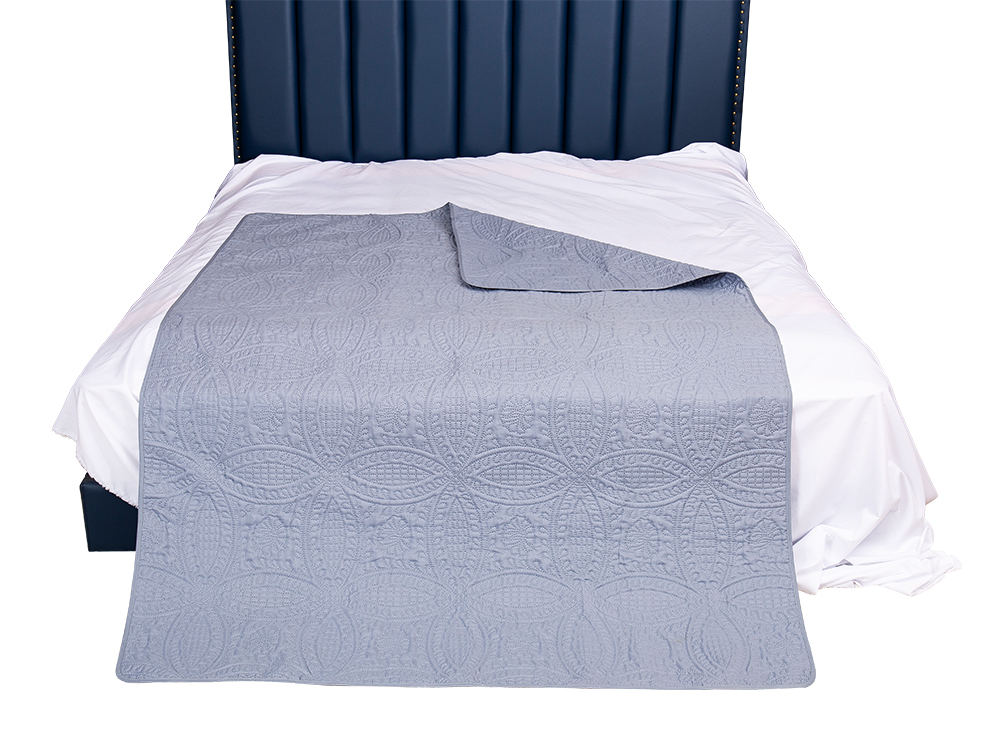
Ultrasonic Polyester Blanket
Key Advantages Compared with Conventional Blanket Options
Distinctive Embossed Appearance
One of the most visible advantages of this product is its embossed surface. Conventional plain blankets can be comfortable and practical, but they may offer limited visual differentiation. An ultrasonic blanket can provide a more designed appearance without requiring complicated surface decoration. The embossed pattern becomes part of the construction itself, allowing the product to look more refined while retaining a relatively straightforward material composition.
This visual quality can be valuable in retail packaging. A blanket with a clear surface pattern may communicate its value more effectively when displayed on a shelf, in an online product image, or within a hotel sample presentation. Pattern selection also allows customers to create product families. A manufacturer can use one design for a basic collection, another for a premium collection, and coordinated designs for quilts, cushions, and mattress protectors.
Lightweight Everyday Comfort
The specified 100gsm bonded polyester filling is suited to a lightweight blanket concept. Many consumers do not want bedding that is overly heavy or difficult to fold. A lighter blanket is easier to carry from one room to another, store in a cabinet, place inside a suitcase, or use as an additional layer on a bed.
Lightweight construction can also support more flexible seasonal use. During warmer periods, the blanket may be used as a primary cover. During transitional weather, it can be combined with other bedding. In hospitality settings, a lightweight blanket can be offered as an extra layer without creating the bulk associated with a heavy comforter.
Efficient Layer Bonding
The ultrasonic process bonds the fabric and filling in a planned pattern. This can help create a stable, neat-looking layered product. A stable construction is useful during packing, transportation, display, and ordinary handling. The surface can remain visually organized rather than appearing loose or uneven when the blanket is folded.
Compared with a blanket that depends on limited joining points, a carefully selected ultrasonic pattern can provide a more systematic approach to layer stabilization. The precise result depends on the pattern and production settings, but the manufacturing concept is well suited to products requiring repeatable appearance across a production order.
Flexible Design Development
Many bedding buyers require more than a standard product. They may need a particular color, size, surface pattern, label arrangement, or packaging format. The ability to customize embossing patterns gives the customer a starting point for product differentiation.
Customization can be particularly useful for wholesalers and importers. A buyer may want a blanket that reflects a regional retail preference, matches an existing bedding range, or supports a seasonal launch. Because the product can be made to a customer’s size requirements, it can be developed for single beds, larger beds, sofa use, travel applications, children’s collections, or other approved dimensions.
Practical Polyester Material
Polyester is widely used in home textiles because it offers versatile processing characteristics. It can be made into fabrics with different weights, colors, and finishes. It is also suitable for large-scale production and supports consistent product planning when the buyer needs repeat orders.
For commercial buyers, polyester can simplify assortment management. A manufacturer can coordinate a blanket with polyester quilts, cushions, mattress protectors, and other textile products. The common material platform may make it easier to plan color matching, packaging, and category expansion.
Clean, Modern Surface Styling
The absence of prominent traditional stitch lines can provide a smooth and contemporary look. This can appeal to brands that emphasize simple design, neutral interiors, and versatile home accessories. The embossed pattern can add visual depth without introducing excessive decoration.
The appearance is also suitable for products intended to be folded or rolled. A repeating pattern can remain recognizable even when the blanket is partially folded, helping customers understand the product’s character from a compact display presentation.
Material Construction and Comfort Considerations
The outer fabric is specified as 80gsm 100% polyester. At this weight, the fabric contributes to a lightweight product profile. Fabric weight is an important factor in blanket engineering because it affects drape, hand feel, packing volume, and the balance between softness and structural stability.
The filling is identified as 100gsm bonded polyester. Bonded polyester filling is designed to provide a consistent layer rather than a loose mass of fibers. In a blanket, the filling creates loft and warmth while contributing to the product’s overall softness. The bonding process also helps the filling remain suitable for the ultrasonic layered construction.
Comfort is influenced by more than filling weight. Surface softness, fabric finish, pattern depth, edge treatment, product size, and the final balance between shell and filling all contribute to the user experience. For this reason, product development should evaluate the complete construction rather than relying on a single specification.
The ultrasonic pattern should be selected with comfort in mind. If the bonding design is too dense, the blanket may become less flexible in those areas. If it is too open, the filling may not receive the desired level of stabilization. A professional manufacturer can assess pattern scale and placement to achieve a practical balance between visual effect, flexibility, and layer security.
The finished edges also deserve attention. Edge construction affects appearance, dimensional stability, and the way the product feels when handled. Depending on the customer’s design, edges may require an appropriate binding, folded finish, or other production treatment. Any edge solution should be compatible with the ultrasonic body construction and the buyer’s packaging requirements.
Color is another important development factor. Polyester fabric can support a broad color program, allowing buyers to select neutral tones, seasonal shades, hospitality colors, or colors coordinated with other bedding products. A color approval process is recommended before bulk production so that the buyer and manufacturer share the same visual standard.
Advanced Manufacturing Capabilities
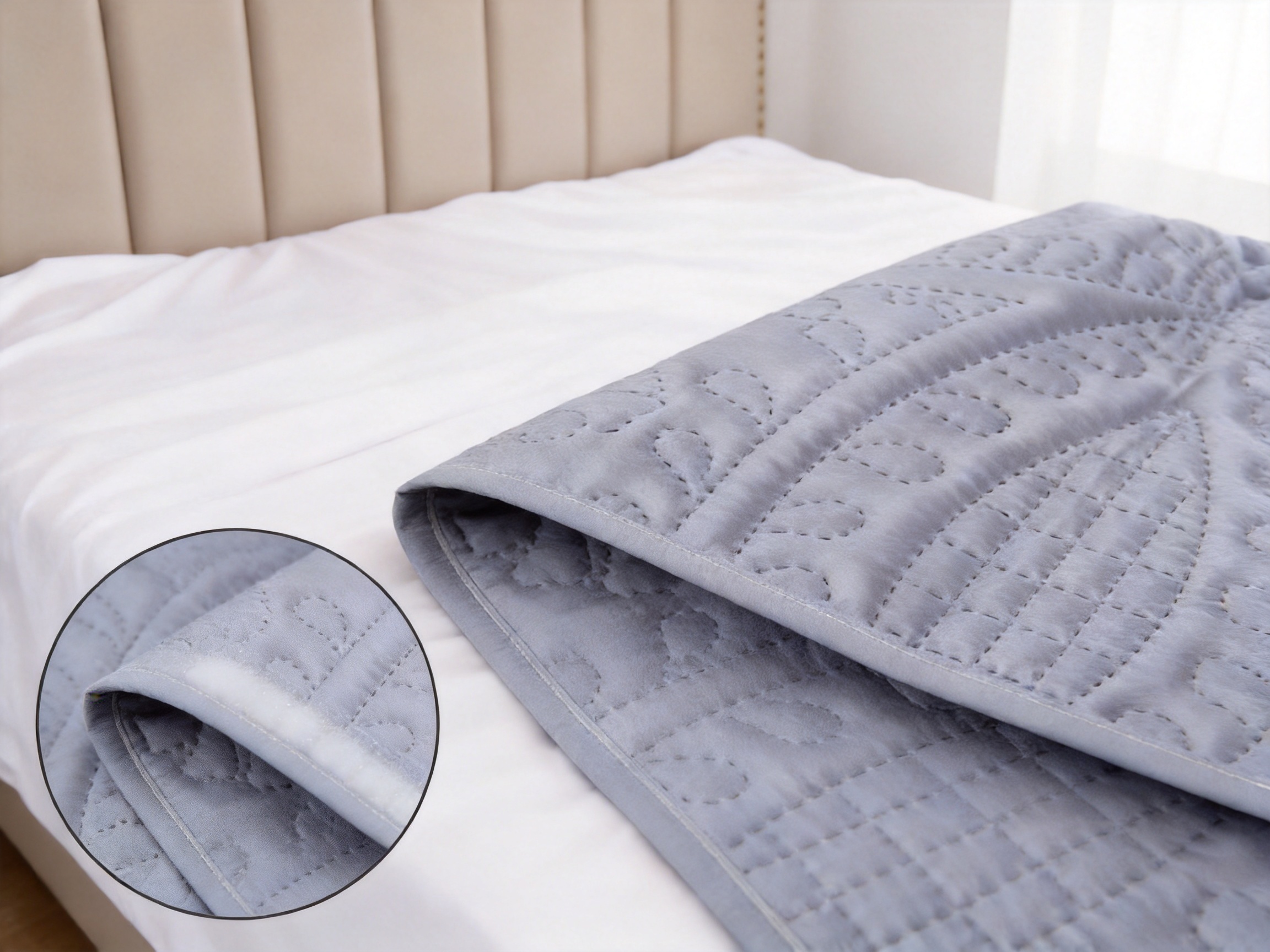
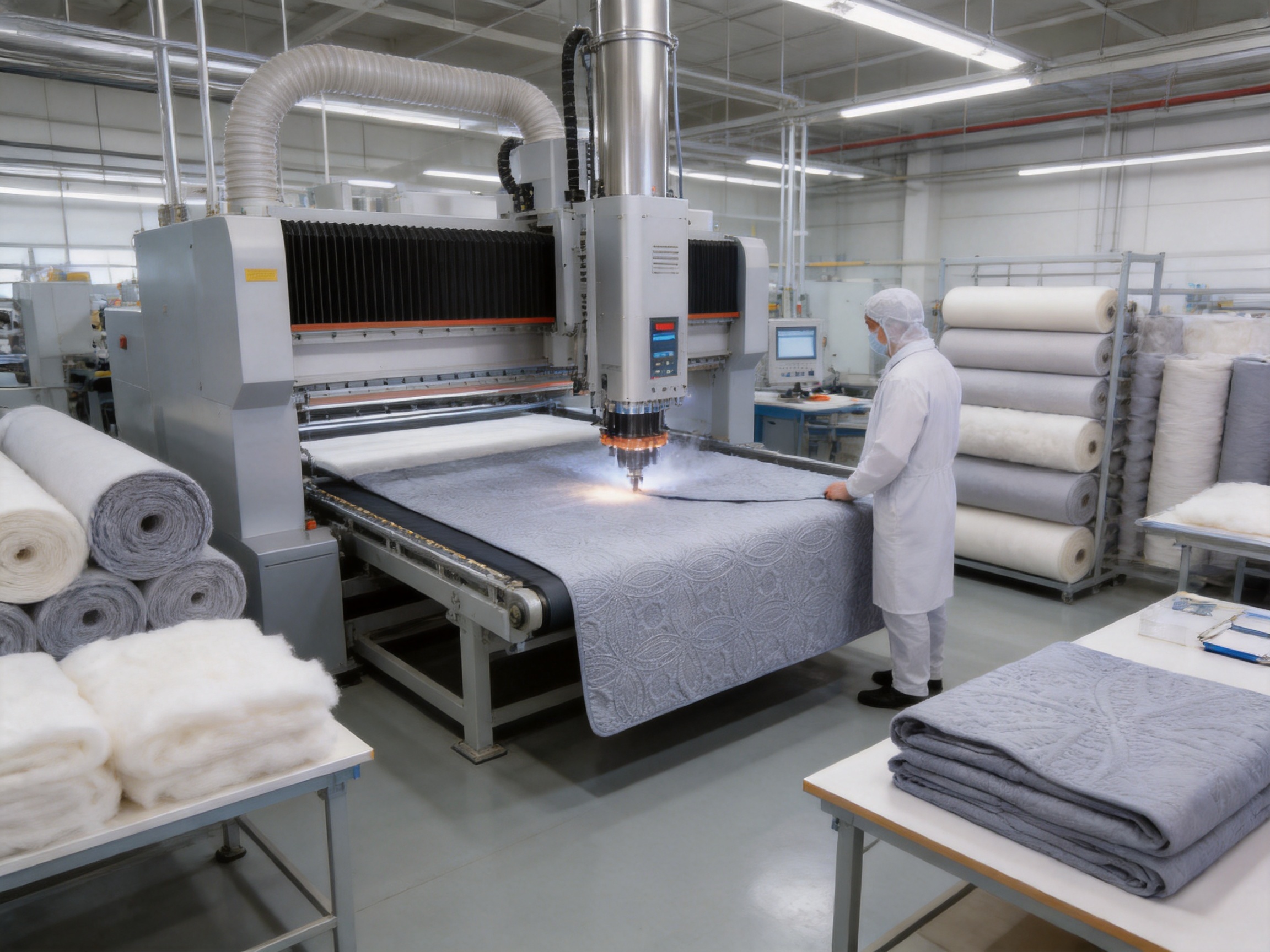
The manufacturer has its own ultrasonic machines and can produce different embossing patterns according to customer requirements. Owning and operating dedicated equipment can provide greater control over development and production than simply outsourcing every specialized operation. It enables the technical team to review pattern ideas, evaluate production feasibility, and adjust processing details based on the actual material combination.
Ultrasonic production requires attention to equipment condition and process consistency. The ultrasonic horn, pattern tooling, pressure system, material feeding method, and operating speed must work together. Small changes in alignment or pressure can influence the appearance of the embossed design. Regular equipment maintenance and process monitoring are therefore important elements of reliable production.
The company’s broader facility profile also supports its manufacturing strength. It covers approximately 21,000 square meters, with a construction area of approximately 18,000 square meters, and has more than 320 employees. A substantial facility and an experienced workforce can support coordinated activities such as material preparation, production scheduling, inspection, packing, and shipment organization.
The company is equipped with various advanced production machines and employs professional technical personnel. This combination matters because equipment alone does not guarantee a successful product. Operators and technicians must understand textile behavior, filling placement, pattern development, quality checkpoints, and the practical requirements of finished bedding.
Experience across multiple home textile categories can also contribute to product development. A manufacturer that produces pillows, quilts, cushions, bedspreads, mattress protectors, and blankets can better understand how different bedding components should coordinate. This category knowledge may help buyers build complete collections rather than sourcing every product from unrelated suppliers.
Production planning is another important strength. For a customized blanket, the manufacturer must coordinate the approved fabric, filling, color, dimensions, embossing tool, labels, packing materials, and inspection requirements. A structured workflow reduces the risk that a design decision made during sampling will be overlooked during bulk production.
Quality Management and Certification Background
Quality is especially important for bedding because the product is used close to the body and handled frequently. The manufacturer states that it has passed international certifications and management standards including ISO 9001, ISO 14001, OEKO-TEX, OEKO-TEX STeP, GRS, and BSCI. These certifications and assessments represent a formal background for quality management, environmental management, textile safety, responsible processing, recycled-content systems where applicable, and social compliance.
Certification should always be understood in relation to the specific product, production site, and current certificate scope. Buyers should request applicable documentation and confirm whether a particular fabric, filling, color, accessory, or order is covered by the relevant standard. Even so, an established certification background demonstrates that the company recognizes the importance of documented systems and responsible manufacturing practices.
ISO 9001 principles are relevant to a customized ultrasonic blanket because they encourage controlled processes, documented procedures, corrective action, and continuous improvement. These practices can support consistency between approved samples and mass-produced goods.
ISO 14001 is associated with environmental management. For textile manufacturing, environmental management may involve resource use, waste handling, chemical control, energy awareness, and process improvement. The exact environmental performance of a product should be assessed through current documentation and customer requirements.
OEKO-TEX-related standards are commonly considered when buyers evaluate textile safety and restricted substances. For a blanket, the assessment may involve fabric, filling, dyes, prints, labels, sewing thread, packaging, and other components. Buyers should clarify the required certification level and product scope before placing an order.
GRS may be relevant when recycled materials are intentionally included and the product is developed under the applicable chain-of-custody requirements. The stated blanket specification identifies polyester materials but does not state that they are recycled. Therefore, recycled-content claims should only be made when supported by the approved material documents and certification scope.
BSCI is associated with social compliance assessment in supply chains. Responsible labor practices are an important part of modern sourcing decisions, particularly for international retailers and brands with formal supplier codes.
The company also states that it has been rated as a safety production standardization enterprise for several consecutive years since 2016. Workplace safety is important for a factory operating cutting, filling, bonding, packing, and other production equipment. Safe operating procedures can help protect employees and support stable production continuity.
From Customer Concept to Finished Blanket
Step One: Requirement Confirmation
Product development begins with a clear understanding of the customer’s intended market and use. Important requirements include finished size, target season, preferred weight, color range, embossing style, packaging method, labeling, order quantity, and delivery schedule.
The customer should also explain whether the blanket is intended for retail, hospitality, promotional distribution, travel, contract furnishing, or private-label bedding. Different applications may prioritize different characteristics. A retail product may emphasize appearance and packaging, while a hospitality product may emphasize standardized dimensions, repeat availability, and easy stock management.
Step Two: Material and Pattern Selection
The specified 80gsm polyester fabric and 100gsm bonded polyester filling provide a defined starting point. The customer and manufacturer can then confirm color, finish, hand feel, and any additional requirements. At this stage, the embossing pattern is considered together with the material thickness and desired visual effect.
Pattern selection should account for repeat size, direction, edge placement, and the way the design will appear on a folded blanket. A pattern that looks attractive in a small sample may require adjustment when expanded to a larger product. The technical team can review the design and identify any areas that may affect bonding or handling.
Step Three: Sample Development
A sample allows the buyer to evaluate the actual material combination and embossed structure. The sample should be reviewed for color, size, pattern clarity, flexibility, surface feel, edge treatment, filling distribution, and general appearance.
It is useful to assess the blanket both unfolded and folded. The buyer should inspect whether the pattern remains consistent across the surface and whether the product fits the intended packaging. If the blanket will be displayed with other products, the sample can also be compared with the planned quilt, pillow, cushion, or mattress protector collection.
Step Four: Production Preparation
After sample approval, the production team prepares the required materials, confirms the ultrasonic tooling, organizes the production schedule, and establishes inspection checkpoints. Approved samples and specifications should be retained as references for the bulk order.
Production preparation may include checking fabric width, verifying filling weight, confirming color lots, reviewing cutting dimensions, and ensuring that labels and packing materials match the purchase order. These controls are particularly important for customized products because small deviations can become more visible when the product includes a repeated embossed design.
Step Five: Ultrasonic Bonding and Finishing
The fabric and filling are positioned and passed through the ultrasonic process according to the selected pattern. The machine applies controlled vibration and pressure to form the intended bonded areas. Operators monitor the appearance and stability of the pattern while maintaining the correct production flow.
After bonding, the blanket receives its finishing treatment. This may include trimming, edge completion, inspection, folding, labeling, and packing. The exact sequence depends on the product specification and the customer’s requirements.
Step Six: Inspection and Packing
Finished products should be inspected for visible defects, incomplete bonding, pattern irregularities, stains, loose material, incorrect dimensions, and packing errors. Inspection standards should be agreed upon before production so that the buyer and manufacturer use consistent criteria.
Packing protects the blanket during storage and transportation. The appropriate package depends on the retail strategy, shipping method, product size, and desired presentation. A compact package can help reduce storage volume, while a display-oriented package may provide stronger retail visibility.
Applications for Different Markets
Residential Bedding
For home use, the ultrasonic polyester blanket can serve as a lightweight bed cover, sofa blanket, guest blanket, or seasonal layer. Its customizable size makes it possible to develop products for different bed dimensions and household preferences. A coordinated embossing pattern can also help the blanket complement bedroom décor.
Hotels and Guest Accommodation
Hotels, serviced apartments, dormitories, and guest houses often require practical bedding that is easy to standardize. A lightweight blanket can be stored as an additional layer and distributed according to guest needs. Custom sizing and private-label options may help accommodation providers maintain a consistent visual identity.
Retail and Private Label
Retailers can use the product as a differentiated alternative to plain polyester blankets. Embossing creates a recognizable surface feature, while customized colors and sizes support different price points and collections. Private-label customers can develop product packaging and labeling around their own market positioning.
Travel and Portable Use
The lightweight construction is suitable for travel-oriented concepts where packability and easy handling are important. It may be considered for use in vehicles, guest rooms, dormitories, airline or rail comfort programs, and portable bedding kits, subject to the buyer’s performance and safety requirements.
Promotional and Institutional Programs
Organizations may order customized blankets for seasonal campaigns, employee gifts, hospitality programs, or institutional furnishing. The embossed surface can provide a more substantial appearance than an entirely plain product, while custom sizing and labeling can support the program’s specific objectives.
How This Product Can Compete Effectively
Competition in the blanket market is not based on one factor alone. Buyers compare price, appearance, materials, production reliability, customization, delivery capability, documentation, and supplier communication. The ultrasonic polyester blanket addresses several of these factors through its combination of a practical polyester construction and a specialized embossing process.
Its principal differentiation is the balance between design and manufacturing efficiency. A blanket can look distinctive without requiring a highly complex collection of materials. The ultrasonic pattern gives the product a recognizable character, while the polyester fabric and bonded filling support a straightforward, scalable construction.
Another competitive point is customization. Standard catalog blankets may be suitable for general resale, but they may not match a buyer’s size, pattern, or collection strategy. The ability to produce various embossing patterns and customize the blanket to any size gives the buyer more control over the finished product.
The manufacturer’s broad home textile experience is also relevant. Buyers seeking multiple categories may benefit from working with a supplier familiar with quilts, pillows, cushions, mattress protectors, bedspreads, and blankets. Coordinated sourcing can simplify communication and help create a consistent product family.
Factory scale, technical personnel, production equipment, and management certifications provide additional sourcing advantages. These factors do not replace product testing or commercial due diligence, but they create a stronger foundation for repeat production than an informal or highly limited operation.
For the product to compete successfully, its advantages should be communicated accurately. The blanket should be presented as lightweight, customizable, embossed, and suitable for practical everyday use. Claims about warmth, durability, environmental performance, safety, or washability should be supported by the exact construction and applicable test results.
Important Testing and Approval Considerations
Before bulk production, buyers should establish a testing and approval plan. The required tests depend on the destination market and the intended application. Common evaluation areas may include dimensional stability, colorfastness, pilling resistance, seam or edge performance, filling distribution, appearance after washing, and resistance to ordinary handling.
Care instructions should be developed from the actual materials and finishing processes. Polyester products may be easy to care for, but the correct washing temperature, drying method, ironing guidance, and chemical restrictions must be confirmed. Ultrasonic bonding and edge finishing should be assessed after the intended care process so that the label instructions are accurate.
Packaging should also be evaluated. A blanket packed too tightly or stored under unsuitable conditions may develop undesirable creasing or compression. The buyer should confirm how the product is folded, how long it may remain compressed, and whether the final presentation meets retail expectations.
Size tolerance is important for customized products. The buyer should specify acceptable dimensional tolerances and decide how measurements will be taken. This is particularly useful when the blanket must fit a specific bed size or be packed together with other products.
Color approval should be based on an agreed standard. Digital images can vary between screens and lighting conditions, so physical samples, approved lab dips, or recognized color references may be needed. Clear approval procedures reduce misunderstandings between development and production.
Sustainability and Responsible Production
Polyester blanket production should be considered from both a material and process perspective. The company’s stated ISO 14001 and GRS-related certification background indicates awareness of environmental management and, where applicable, recycled-material systems. However, customers should distinguish between general factory certifications and claims that apply specifically to a finished product.
If a buyer requires recycled polyester, the fabric and filling should be specified accordingly before production. Documentation should confirm the material source and the applicable certification chain. If recycled content is not requested or verified, the product should simply be described according to its confirmed polyester composition.
Ultrasonic processing can be part of an efficient construction approach because it creates bonded areas through controlled heat and vibration rather than depending entirely on thread-based joining. The environmental effect of the complete product still depends on electricity consumption, material sourcing, waste levels, packaging, transportation, and end-of-life conditions.
Responsible production also includes employee safety, proper operating procedures, and social compliance. The company’s stated BSCI background and safety standardization record are relevant points for buyers evaluating supplier responsibility. Current documentation and audit status should be checked as part of the sourcing process.
Ordering and Customization Guidance
A successful order begins with a detailed product brief. The brief should identify the blanket category, finished dimensions, fabric composition, filling composition, target weight, color, embossing pattern, edge style, label requirements, packaging, quantity, and delivery expectations.
Customers should provide artwork or visual references for a customized embossing design whenever possible. The manufacturer can then review whether the design is suitable for ultrasonic production. Some patterns may require adjustment because of repeat size, narrow lines, close spacing, asymmetry, or the relationship between the pattern and the blanket edge.
It is also helpful to confirm whether the same design should be applied across a product family. For example, a buyer may want the blanket pattern to coordinate with a quilt or cushion. The manufacturer’s experience across several home textile categories may support this type of coordinated development.
Sampling is recommended before finalizing a large order. The approved sample should represent the intended fabric, filling, pattern, dimensions, and finishing. If any component changes after approval, a revised sample or documented confirmation may be appropriate.
Buyers should discuss production lead time, minimum order quantity, packing method, inspection arrangements, and shipping plans at the beginning of the project. These commercial details can influence the choice of materials, pattern tooling, and production schedule.
Care, Storage, and Product Presentation
The product should be stored in a clean, dry environment protected from excessive moisture, heat, dust, and direct sunlight. Proper storage helps preserve the fabric appearance and packaging condition before the blanket reaches the final user.
For presentation, the blanket can be folded to show a representative section of its embossed pattern. Retail imagery should display the overall scale, surface texture, color, and drape. Product information should state the confirmed fabric and filling details, size, care instructions, and any relevant certification information.
Because the blanket is customizable, packaging language should be aligned with the actual order. A package should not claim a higher filling weight, special fiber origin, antibacterial treatment, waterproof performance, or environmental attribute unless that feature has been specifically developed and verified.
Clear presentation helps the product compete on value rather than price alone. Customers can understand that the blanket combines a specialized production method, a layered textile structure, and a design that can be adapted to different markets.
Quality Control Checklist
| Inspection Area | What to Review |
|---|---|
| Materials | Confirm fabric composition, fabric weight, filling type, and approved color |
| Dimensions | Measure finished length and width against the agreed specification |
| Embossing | Check pattern clarity, repeat accuracy, alignment, and bonding continuity |
| Filling | Review evenness, thickness, and areas with possible displacement |
| Surface | Look for stains, holes, marks, creases, loose fibers, or unacceptable defects |
| Edges | Inspect edge security, neatness, straightness, and consistency |
| Labels | Verify care labels, composition labels, brand labels, and placement |
| Packing | Confirm folding, quantity, package condition, carton marks, and shipping protection |
Q&A: Common Questions About Ultrasonic Polyester Blankets
What is an ultrasonic polyester blanket?
It is a layered blanket made from polyester fabric and polyester filling that are joined in selected areas through ultrasonic heat and pressure. The process creates an embossed or quilted surface pattern while helping stabilize the construction.
What materials are used in this product?
The specified construction uses 80gsm 100% polyester fabric and 100gsm bonded polyester filling. Customers should confirm whether any changes are required for a particular season, market, or application.
Can the embossing pattern be customized?
Yes. The manufacturer has ultrasonic machines and can produce various embossing patterns according to customer requirements. A sample and technical review are recommended before bulk production.
Can the blanket be made in different sizes?
Yes. The stated size is customizable to any size. The buyer should provide the required finished dimensions and acceptable tolerances at the quotation and sampling stage.
Is the blanket suitable for cold winter conditions?
The specified construction is a lightweight blanket with 100gsm bonded polyester filling. It may be suitable as a moderate layer or for mild and transitional conditions. Suitability for severe cold depends on the intended environment, room temperature, layering system, and customer expectations.
What makes the blanket different from a plain polyester blanket?
The primary difference is the ultrasonic embossed construction. It creates a decorative surface and a planned bonding structure, giving the product a more distinctive appearance than a basic plain blanket.
Is ultrasonic bonding the same as sewing?
No. Sewing uses needle and thread, while ultrasonic bonding uses high-frequency vibration, heat, and pressure to join compatible layers. Both methods require suitable construction and quality control, but they produce different visual and technical results.
Can the blanket be used in a coordinated bedding collection?
Yes. The manufacturer produces several home textile categories, including quilts, pillows, cushions, mattress protectors, bedspreads, and other bedding products. Buyers can discuss matching colors, patterns, sizes, and packaging across a collection.
Does the product use recycled polyester?
The supplied specification identifies polyester fabric and bonded polyester filling but does not state that the materials are recycled. Recycled content should only be claimed when it is specifically ordered, documented, and covered by the applicable certification requirements.
What certifications are associated with the manufacturer?
The manufacturer states that it has passed ISO 9001, ISO 14001, OEKO-TEX, OEKO-TEX STeP, GRS, and BSCI-related international certifications or assessments. Buyers should request current documents and verify the scope relevant to the particular product.
What should be checked before placing a bulk order?
Buyers should approve the fabric, filling, color, dimensions, embossing pattern, edge finish, labels, packaging, care instructions, inspection standard, and applicable test or certification documents.
Who may benefit from this product?
Retailers, wholesalers, private-label brands, hotels, furnished accommodation providers, institutional buyers, promotional distributors, and home textile importers may all consider the product, provided that its lightweight construction and customization options match their requirements.
Conclusion
The ultrasonic polyester blanket combines a practical textile construction with a specialized embossing process. Its 80gsm polyester fabric and 100gsm bonded polyester filling create a lightweight bedding product that can be adapted for everyday residential use, hospitality programs, retail collections, travel concepts, and private-label projects.
Its strongest commercial advantages are the distinctive embossed surface, flexible pattern development, customizable sizing, manageable weight, and compatibility with coordinated home textile ranges. The product can offer a clear alternative to plain blankets while maintaining a straightforward polyester-based construction suitable for organized production.
The manufacturing background adds further value. Dedicated ultrasonic machines, professional technical personnel, advanced production equipment, a sizable facility, more than 320 employees, and experience across multiple bedding categories create a strong platform for customization and repeat orders. The stated ISO, OEKO-TEX, GRS, BSCI, environmental, and safety-related background provides additional points for buyers to review during supplier qualification.
For the best result, buyers should treat the blanket as a complete engineered product rather than focusing only on the surface pattern. Fabric, filling, bonding density, edge treatment, dimensions, care instructions, packaging, testing, and certification documents should all be confirmed together. With clear specifications and careful sample approval, the ultrasonic polyester blanket can become a practical, visually distinctive, and commercially flexible addition to a modern home textile collection.
References
1. Product specification supplied for the ultrasonic polyester blanket, including fabric, filling, size, product category, and embossing capability.
2. Company information supplied for Tongxiang Xinlong Bedding Co., Ltd., including facility size, employee count, product categories, equipment, technical personnel, and certification background.
3. General textile manufacturing principles relating to ultrasonic bonding, heat-press joining, quilted construction, polyester fabrics, and bonded polyester filling.
4. General quality management principles associated with ISO 9001 and environmental management principles associated with ISO 14001.
5. General textile safety, recycled-material chain-of-custody, social compliance, and responsible production principles associated with OEKO-TEX, GRS, BSCI, and related certification systems.


 +86-573-88798028